

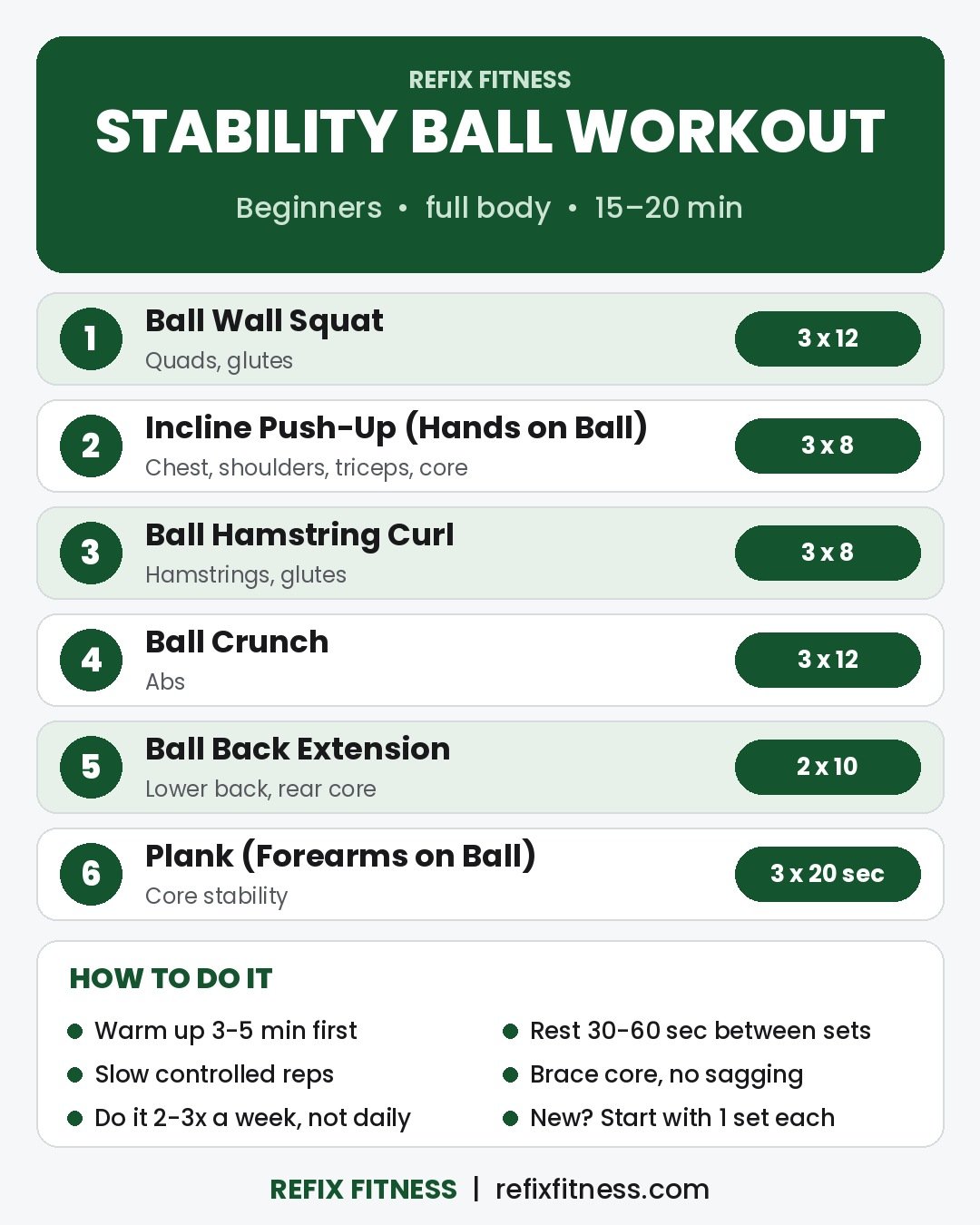
Quick answer: A stability ball workout for beginners at home can train your legs, chest, back and core with one Swiss (yoga or exercise) ball and about 15–20 minutes. This beginner plan uses 6 moves: ball wall squat, incline push-up with hands on the ball, ball hamstring curl, ball crunch, ball back extension and a forearm plank on the ball. Do 2–3 sets of each with slow, controlled reps, rest 30–60 seconds between sets, and repeat the workout 2–3 times a week on non-consecutive days.
Why Train With a Stability Ball?
A stability ball (also called a Swiss ball, yoga ball or exercise ball) turns everyday strength moves into a balance challenge. Your core has to stay gently braced so you don’t tip, which often makes beginners feel more worked than they expect from bodyweight alone.
Mayo Clinic’s fitness ball guide covers how to choose a ball and how to perform common exercises with good form. Start with a ball that lets you sit with your knees and hips at about a right angle, and inflate it until it feels firm but not rock-hard.
If you want a gentler, age-focused ball routine, see our stability ball workout for women over 50. For a glute-focused ball session, try our stability ball glute workout.
What You’ll Need
- One stability ball. A standard anti-burst exercise ball is enough. No weights needed.
- A clear wall for the wall squat, plus a yoga mat or carpet for floor moves.
- About 15–20 minutes, including a short warm-up.
- Shoes with grip (or bare feet on a non-slip mat) so nothing slides.
How Do You Choose the Right Ball Size?
Sit on the ball with your feet flat on the floor. Your knees and hips should sit at roughly 90 degrees, with your thighs parallel to the floor. Many brands suggest a 55 cm ball for about 5’1″–5’7″ and a 65 cm ball for about 5’8″–6’1″; shorter and taller people often need 45 cm or 75 cm. Treat those as starting points. If the ball feels mushy, add air. If it feels rock-hard, let a little air out.
Ball Safety Checks
- Buy an anti-burst ball rated for your body weight.
- Inspect it before each workout for soft spots, cracks or leaks.
- Use a non-slip surface away from sharp furniture edges, and keep a hand free the first few times you try a new move.
Stability Ball Workout for Beginners at Home: The 6-Move Plan
Warm up for about 3–5 minutes: march in place, then do 10 arm circles, 10 hip circles and 8–10 bodyweight squats. Practice a few reps of each move with your hands nearby for balance. Do the moves in order, rest 30–60 seconds between sets, and start with 1–2 sets in week one if you are new.
| # | Exercise | Sets x Reps | Main Focus |
|---|---|---|---|
| 1 | Ball Wall Squat | 3 x 12 | Quads, glutes |
| 2 | Incline Push-Up (Hands on Ball) | 3 x 8 | Chest, shoulders, triceps, core |
| 3 | Ball Hamstring Curl | 3 x 8 | Hamstrings, glutes |
| 4 | Ball Crunch | 3 x 12 | Abs |
| 5 | Ball Back Extension | 2 x 10 | Lower back, rear core |
| 6 | Plank (Forearms on Ball) | 3 x 20 sec | Core stability |
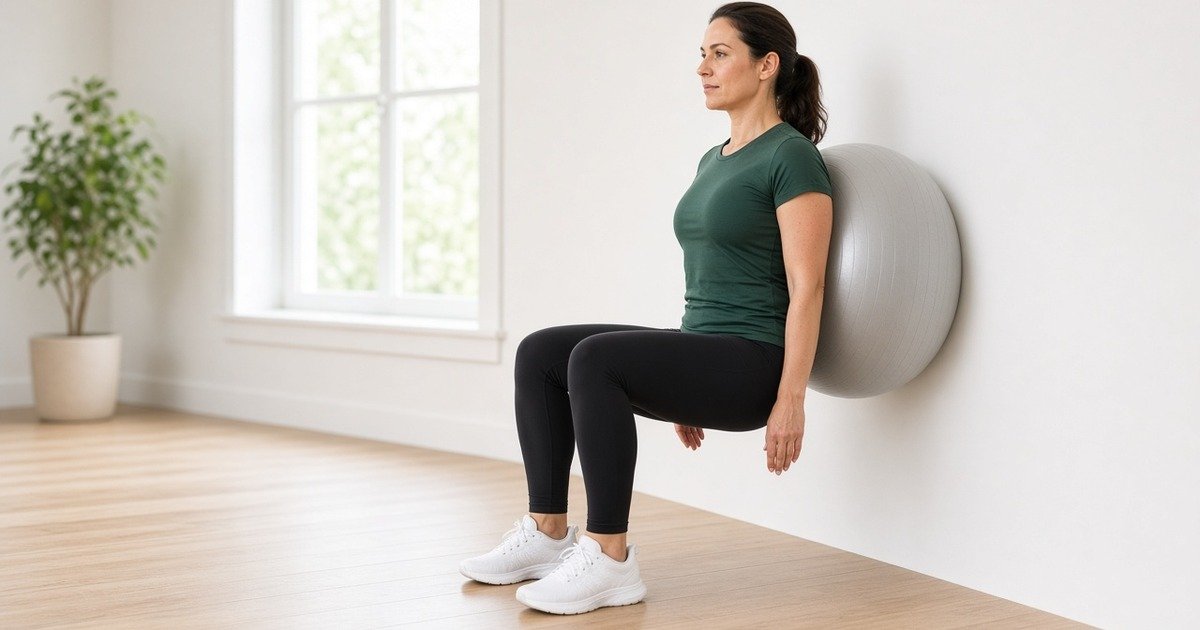
1. Ball Wall Squat
Builds strength in your thighs and glutes while the ball supports your back against the wall.
- Place the ball between your lower back and a clear wall. Stand with feet hip-width apart, a step or two in front of the wall.
- Lean gently into the ball. Keep your chest tall and your weight in your heels.
- Bend your knees and sit as if into a chair, letting the ball roll up your back, until your thighs are about parallel to the floor (or as low as feels comfortable).
- Press through your heels to stand back up.
Form cues: keep your knees tracking over your mid-foot, not collapsing inward. Don’t let your heels lift.
Easier: squat only partway down, or hold a sturdy chair for balance. Harder: pause 2–3 seconds at the bottom.
2. Incline Push-Up (Hands on Ball)
Trains your chest, shoulders and triceps, while the ball asks your core to stay steady.
- Kneel behind the ball and place both hands on top, fingers spread, about shoulder-width apart.
- Walk your feet back until your body forms a straight line from head to heels (or knees for a modified version).
- Bend your elbows and lower your chest toward the ball, elbows about 45 degrees from your ribs.
- Press the ball away to return without locking your elbows hard.
Form cues: brace your stomach, keep your neck long, and look slightly ahead of the ball. If it rolls a lot, place it against a wall for your first sets.
Easier: keep your knees on the floor, or put your hands on a sturdy chair instead. Harder: take 3 seconds to lower each rep.
3. Ball Hamstring Curl
Works the backs of your thighs and your glutes, and challenges your hips to stay level.
- Lie on your back with arms by your sides, palms down. Place your heels on top of the ball, legs straight.
- Lift your hips into a bridge so your body forms a straight line from shoulders to heels.
- Keeping your hips up, bend your knees and roll the ball toward your glutes by digging your heels in.
- Slowly straighten your legs to roll the ball away. Lower your hips between reps if you need a break.
Form cues: squeeze your glutes and keep your ribs down so your lower back doesn’t arch. Move slowly.
Easier: hold a glute bridge with feet on the ball and skip the curl for a few weeks. For a no-ball option, see our bodyweight glute workout for beginners at home. Harder: pause 2 seconds with the ball tucked in, or keep your hips high for the whole set.
4. Ball Crunch
Strengthens your abs with support from the ball under your mid-back.
- Sit on the ball, then walk your feet forward until the ball is under your mid-back and your head and shoulders are free. Knees bent, feet flat and hip-width apart.
- Place your hands lightly behind your head or across your chest.
- Curl your ribcage toward your pelvis, lifting your shoulders a few inches. Exhale as you crunch.
- Lower slowly until your back rests on the ball again. Avoid dropping into a deep backbend if that feels uncomfortable.
Form cues: lead with your chest, not your chin. Keep your feet planted so the ball stays still.
Easier: keep your hands on your thighs and slide them toward your knees as you crunch. Harder: hold the top for 2 seconds, or cross your arms over your chest.
5. Ball Back Extension
Strengthens the muscles along your lower and mid-back to balance the ab work from the crunch.
- Kneel behind the ball and drape your torso over it so your hips rest near the top. Touch the floor lightly with your hands for balance if needed.
- Walk your feet back until your legs are mostly straight and your toes are on the floor.
- Cross your arms over your chest. Lift your chest a few inches by lengthening through your spine, looking at the floor a few feet ahead.
- Lower with control. Stop short of any pinching in your lower back.
Form cues: move from your mid-back, not by yanking your neck. Keep the range small at first.
Easier: keep both hands on the floor and lift only a tiny amount. Harder: hold the top for 2 seconds, or place your hands lightly behind your head.
6. Plank With Forearms on Ball
Builds core stability; the ball’s wobble makes a short hold feel harder than a floor plank.
- Kneel in front of the ball and place both forearms on top, elbows under your shoulders.
- Step your feet back until your body forms a straight line from head to heels (or knees for a modified version).
- Brace your stomach, squeeze your glutes lightly and hold without letting your hips sag or pike up.
- Breathe steadily. Hold about 20 seconds, then rest and repeat.
Form cues: keep your neck long and your shoulders away from your ears. If the ball rolls, shorten the hold or place it against a wall.
Easier: hold with your knees on the floor, or do a forearm plank on the floor. Harder: hold 30–40 seconds. For low-impact cardio around this strength work, try our low-impact fat burning workout at home with no jumping.
Sample Weekly Plan
Do this workout 2–3 times a week on non-consecutive days. Here is one way to fit it around walking:
| Day | What to Do |
|---|---|
| Monday | Stability ball full-body workout |
| Tuesday | Brisk walk, 20–30 minutes |
| Wednesday | Lower body or glute focus (optional) |
| Thursday | Brisk walk or gentle stretching |
| Friday | Stability ball full-body workout |
| Saturday | Long walk or bike ride |
| Sunday | Rest |
For a lower-body day without the ball, our lower body workout for beginners over 50 at home is a calm, joint-friendly option.
This lines up with the CDC’s guidance for adults: 150 minutes of moderate-intensity activity and 2 days of muscle-strengthening each week, with any amount of activity offering some health benefits.
How to Progress Over the Weeks
Change one thing at a time:
- Weeks 1–2: 1–2 sets of each move. Focus on balance and form; use the easier options if needed.
- Weeks 3–4: 2–3 sets as listed in the plan.
- Weeks 5 and beyond: slow the lowering part to 3 seconds, add a few reps, or lengthen plank holds by 5–10 seconds.
If a move still feels shaky, keep the easier version. Progress is about control, not how fast the ball moves.
Common Mistakes to Avoid
- Rushing the reps. Count to 2 on the way down and 2 on the way up.
- Letting your hips sag in the plank or push-up. Brace your midsection and squeeze your glutes lightly.
- Arching hard through the lower back on the crunch or back extension. Use a small, controlled range.
- Knees collapsing inward on the wall squat. Keep them tracking over your mid-foot.
- Holding your breath. Exhale on the effort; inhale on the return.
Safety Tips
- Check with your doctor first if you haven’t exercised in a while, are pregnant or recently gave birth, or have balance issues, back problems, high blood pressure, a heart condition or a recent injury or surgery.
- Stop if something feels wrong. Sharp pain, dizziness, numbness or chest discomfort are signs to stop. Get medical advice if they don’t settle.
- Clear your space so a rolling ball can’t hit furniture edges or glass.
FAQ
Is a stability ball workout for beginners at home enough for a full-body session?
Yes, for a beginner strength session. This plan hits your legs, pushing muscles, posterior chain and core in about 15–20 minutes. Pair it with walking or other cardio on other days to cover weekly activity guidance.
How often should I do this Swiss ball routine?
Two to three times a week on non-consecutive days is a good starting point, so your muscles get a day to recover. Two sessions a week is enough to begin with.
What size stability ball should a beginner buy?
Buy a size that lets you sit with your knees and hips near 90 degrees when your feet are flat. Many people between about 5’1″ and 5’7″ start with a 55 cm ball; taller people often need 65 cm. Check the brand chart and sit-test before you commit.
Can I do this workout if I have lower back discomfort?
Back discomfort has many causes, so ask a doctor or physical therapist before starting. If you get the all-clear, keep ranges small, use the easier options and skip any move that increases pain.
Do I need weights with the exercise ball?
Not for this beginner plan. Bodyweight plus the ball’s instability is enough to start. Add light dumbbells later only if every set still feels easy with good form.
Disclaimer: This article is for general information only and is not medical advice or a substitute for advice, diagnosis, or treatment from a qualified doctor. Please talk to a healthcare professional before starting a new exercise program, especially if you have a health condition, and read our full disclaimer.
Disclaimer: This article is for general information only and is not a substitute for advice, diagnosis or treatment from a qualified doctor. Please talk to a healthcare professional before changing your diet, exercise or medicines, especially if you are pregnant, breastfeeding or have a health condition, and read our full disclaimer.