
Low Impact Fat Burning Workout at Home (No Jumping): 6 Beginner Moves
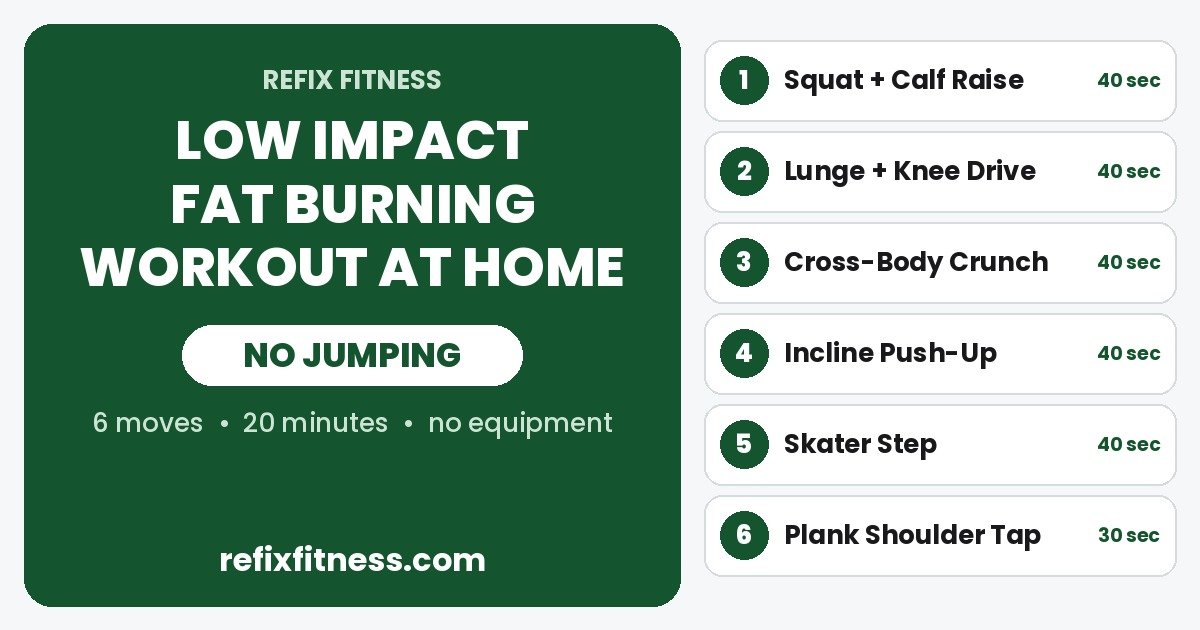
Quick answer: A low impact fat burning workout at home with no jumping uses big, full-body moves done back to back to raise your heart rate, while one foot (or your hands) always stays on the floor. This 6-move circuit uses squat to calf raises, reverse lunges with a knee drive, standing cross-body crunches, incline push-ups, skater steps and plank shoulder taps. Do each move for 40 seconds (30 seconds for the plank), rest 20 seconds, and repeat for 3 rounds. It takes about 20 minutes, needs no equipment, and is quiet enough for an apartment.
Jumping jacks and burpees are not the only way to get sweaty. If you have achy knees, downstairs neighbors or you’re new to exercise, this apartment-friendly routine lets you work hard without the pounding. Below are the plan, step-by-step form tips, easier and harder options, a sample week and common mistakes.
What “Fat Burning” Really Means Here
No workout melts fat from one spot, and nobody can promise how many calories you’ll burn, since that depends on your body, effort and fitness. What this circuit can do is keep your heart rate up for about 20 minutes while working your legs, glutes, core, chest and arms. Done regularly, alongside sensible eating, good sleep and daily movement, that supports fat loss over time.
The key is effort. The NHS describes moderate activity as something that raises your heart rate and makes you breathe faster and feel warmer; a simple check is that you can still talk, but not sing. Aim for at least that level during each 40-second interval. Low impact does not have to mean low effort.
Low Impact Fat Burning Workout at Home (No Jumping): The Plan
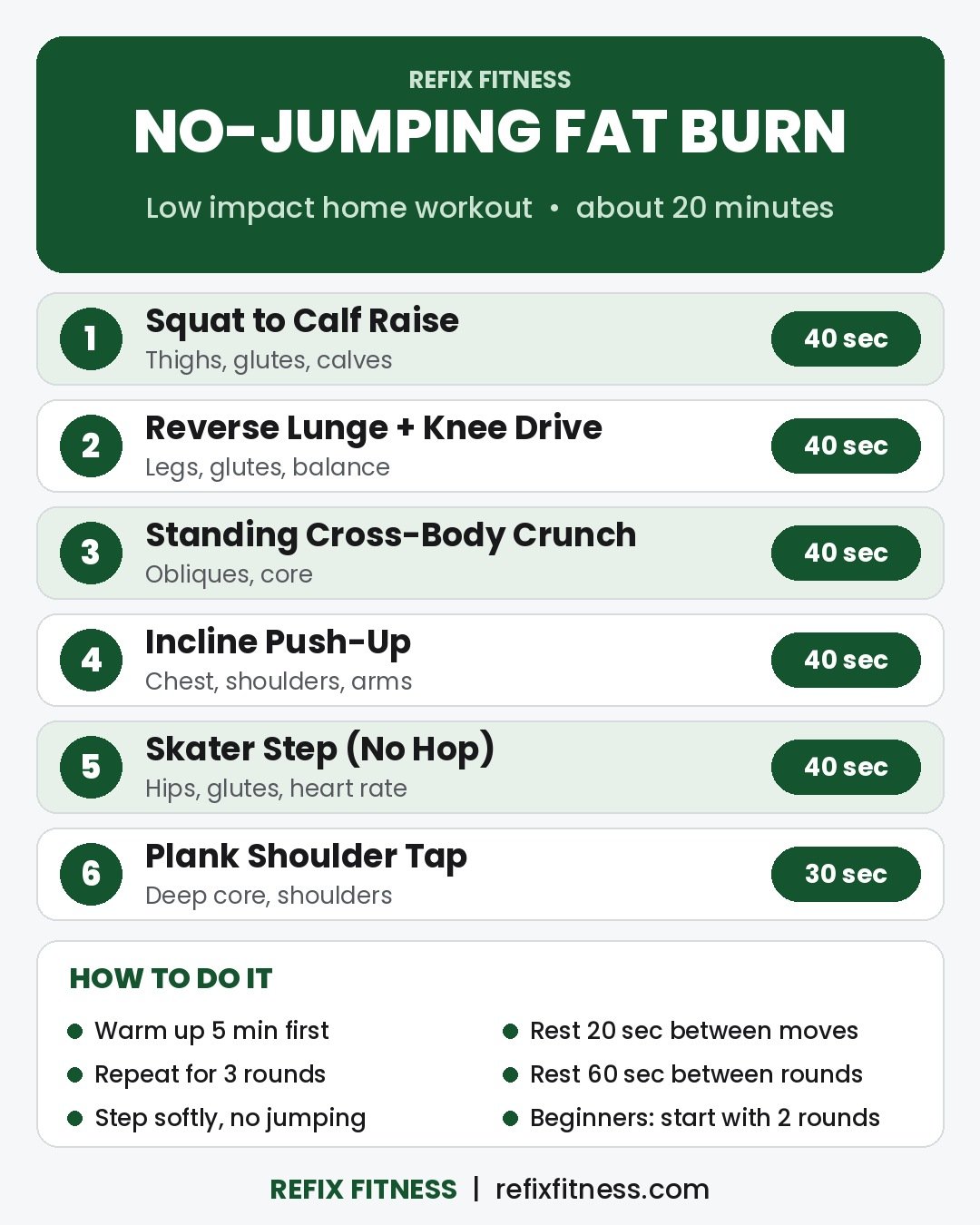
Warm up for 5 minutes first: march in place, swing your arms, do slow bodyweight squats, and circle your hips and shoulders. Then work through the circuit below. Do every move once, in order, resting 20 seconds between moves. Rest about 60 seconds after the last move, then repeat for 3 rounds in total. Beginners can start with 2 rounds.
| # | Exercise | Work | Main Focus |
|---|---|---|---|
| 1 | Squat to Calf Raise | 40 seconds | Thighs, glutes, calves |
| 2 | Reverse Lunge with Knee Drive | 40 seconds | Legs, glutes, balance |
| 3 | Standing Cross-Body Knee Crunch | 40 seconds | Obliques, hip flexors |
| 4 | Incline Push-Up | 40 seconds | Chest, shoulders, arms, core |
| 5 | Skater Step (No Hop) | 40 seconds | Outer hips, glutes, heart rate |
| 6 | Plank Shoulder Tap | 30 seconds | Deep core, shoulders |
You’ll need a mat or carpet and a sturdy surface for the incline push-up, such as a kitchen counter or a couch pushed against a wall. Wear supportive shoes or go barefoot on a non-slip surface.
How to Do Each Move
1. Squat to Calf Raise
Big leg muscles plus a small rise onto your toes, with no need to leave the floor.
- Stand with your feet about hip- to shoulder-width apart, toes pointing forward or slightly out.
- Push your hips back and bend your knees to lower into a squat, keeping your chest up.
- Drive through your whole foot to stand up.
- At the top, rise onto the balls of your feet, pause for a beat, and lower your heels with control.
Form cues: knees track in line with your toes, weight stays in the middle of your feet in the squat, and you lower your heels slowly instead of dropping them.
Easier: squat only halfway down, or squat to a chair and skip the calf raise. Harder: add a 2-second pause at the bottom of each squat, or reach your arms overhead as you rise onto your toes.
2. Reverse Lunge with Knee Drive
Stepping backward is usually gentler on the knees than a forward lunge, and the knee drive adds a balance challenge that gets your heart working.
- Stand tall with your feet hip-width apart.
- Step your right foot back and bend both knees to lower into a lunge.
- Push through your front (left) foot to stand up, and drive your right knee up toward your chest.
- Step straight back into the next lunge. Switch legs halfway through the 40 seconds.
Form cues: keep most of your weight in your front heel, keep your torso upright, and lower your back knee softly toward the floor rather than banging it down.
Easier: hold a chair or wall for balance, take a shorter step, and tap your foot down instead of driving the knee. Harder: move a little faster while keeping control, or add a pause with the knee up.
3. Standing Cross-Body Knee Crunch
A standing core move that keeps the pace up.
- Stand with your feet wider than hip-width and place your hands lightly behind your head, elbows wide.
- Lift your right knee up and across your body as you twist your torso to bring your left elbow toward it.
- Return to standing and repeat on the other side. Keep alternating.
Form cues: breathe out as the knee and elbow come together, crunch through your waist instead of pulling on your neck, and keep the standing knee slightly soft.
Easier: do it slowly, or lift the knee straight up in front instead of across. Harder: pick up the pace, or do all reps on one side for 20 seconds before switching.
4. Incline Push-Up
Raising your hands takes some body weight off your arms, so you can do good-quality reps for your chest, shoulders and core.
- Place your hands on a sturdy counter, table or couch seat, a little wider than your shoulders.
- Walk your feet back until your body forms a straight line from head to heels.
- Bend your elbows, angled about 45 degrees from your body, and lower your chest toward the edge.
- Press back up to straight arms without letting your hips sag.
Form cues: squeeze your glutes and brace your stomach, keep your neck long, and lower for about two seconds each rep. Make sure the surface cannot slide or tip.
Easier: use a higher surface, like a wall or counter. Harder: use a lower surface, such as a sturdy step or couch seat, or try a regular push-up from the floor.
5. Skater Step (No Hop)
The quiet version of the skater jump: the same side-to-side leg work, with no landing.
- Stand with your feet together and bend your knees slightly.
- Take a big step out to the right with your right foot, then sweep your left foot behind your right leg in a gentle curtsy, tapping the toes down.
- Swing your arms across your body as you step, like a speed skater.
- Step back out to the left and repeat on the other side. Keep alternating.
Form cues: stay low with your hips back, keep your chest up, and land the stepping foot softly and flat.
Easier: take smaller steps and skip the curtsy, just tapping the trailing foot next to the other. Harder: sink lower into each step and move faster, still keeping one foot on the floor.
6. Plank Shoulder Tap
The finisher works your deep core, because your body must stay still while one hand lifts.
- Start in a high plank with your hands under your shoulders and your feet a little wider than hip-width.
- Brace your stomach and squeeze your glutes so your body is in a straight line.
- Lift your right hand and tap your left shoulder, then put it back down.
- Repeat with your left hand. Keep alternating for 30 seconds.
Form cues: keep your hips as still as possible, as if balancing a glass of water on your lower back, and move slowly. Wider feet make it more stable.
Easier: do it from your knees, or with your hands on the same counter you used for push-ups. Harder: bring your feet closer together, or pause for a second on each tap.
Sample Weekly Plan for Beginners
The CDC recommends that adults get at least 150 minutes of moderate-intensity activity a week, plus muscle-strengthening activity on 2 or more days that works all major muscle groups. This workout covers both legs and upper body, and walking can fill in the rest of your weekly minutes. Here’s a simple week:
- Monday: No-jumping workout, 2-3 rounds
- Tuesday: Brisk walk, 20-30 minutes
- Wednesday: No-jumping workout, 2-3 rounds
- Thursday: Walk plus 10 minutes of gentle stretching
- Friday: No-jumping workout, 3 rounds
- Saturday: Longer walk, bike ride, swim or dance session, 30-45 minutes
- Sunday: Rest
How to progress: once 3 rounds feel manageable, change one thing at a time. Cut rest to 15 seconds, extend work to 45 seconds, or add a fourth round. Don’t change everything in the same week.
Exercise works best alongside daily habits. For simple ideas outside your workouts, see our guide to natural ways to boost metabolism, and build your meals around the best foods for weight loss that keep you full.
Common Mistakes to Avoid
- Going too easy. Low impact is about the floor, not the effort. If you could comfortably sing during an interval, move a bit faster or go deeper.
- Rushing and losing form. Quality reps first, then speed.
- Stomping. Landing heavily on the skater step or lunge defeats the purpose. Step softly and quietly; if your neighbors can hear you, slow down.
- Holding your breath. Breathe out on the hardest part of each move, like standing up from the squat or pushing up from the counter.
- Skipping the warm-up and cool-down. Warm up for 5 minutes and finish with easy walking and stretching.
Safety Tips
- Check with your doctor first if you haven’t exercised for a while, are pregnant or recently gave birth, or have a heart, joint, or other health condition.
- Use stable support. Only do incline push-ups on a surface that cannot slide or tip, and keep a chair or wall nearby for lunges and skater steps.
- Stop if something hurts. Muscle tiredness is normal. Sharp or joint pain, dizziness, chest discomfort, or unusual shortness of breath are signs to stop and get medical advice.
- Protect sore knees. Use a smaller range of motion on squats and lunges, and use the easier versions. Our article on home remedies for knee pain has everyday tips, but ongoing knee pain should be checked by a professional.
- Take care of your wrists. If planks and push-ups bother your wrists, use a higher surface so less weight goes through your hands.
FAQ
Can a low impact workout with no jumping really help with fat loss?
It can be part of the picture. Fat loss depends on your overall habits over time, including diet, daily movement and sleep. A no-jumping circuit that raises your heart rate and works your major muscles is a joint-friendly way to exercise regularly. Effort matters more than whether your feet leave the floor.
How often should I do this workout?
Three non-consecutive days a week is a good start, with walking on the days in between. If you’re very new to exercise, begin with two days and two rounds.
Is this workout good for beginners and people with knee pain?
It was written with beginners in mind, and every move has an easier option. People with sore knees often find low impact moves more comfortable than jumping, but knee problems vary. Use a smaller range of motion, avoid anything that causes pain, and ask a doctor or physical therapist if you’re unsure.
Is this workout quiet enough for an apartment?
Yes. There are no jumps or hard landings, so the main noise is your feet stepping. A mat or rug and soft, controlled steps keep it even quieter.
How long until I notice results?
Many people find the routine feels easier within a few weeks of consistent practice. Visible changes take longer and depend on nutrition, sleep and overall activity, so focus on showing up regularly.
Disclaimer: This article is for general information only and is not medical advice or a substitute for advice, diagnosis, or treatment from a qualified doctor. Please talk to a healthcare professional before starting a new exercise program, especially if you have a health condition, and read our full disclaimer.
Disclaimer: This article is for general information only and is not a substitute for advice, diagnosis or treatment from a qualified doctor. Please talk to a healthcare professional before changing your diet, exercise or medicines, especially if you are pregnant, breastfeeding or have a health condition, and read our full disclaimer.
