

Quick answer: A dumbbell lower body workout at home with no bench can train your quads, glutes, hamstrings and calves using just a pair of dumbbells (or even one) and some floor space. This plan uses 6 moves: goblet squat, Romanian deadlift, reverse lunge, split squat, dumbbell glute bridge and calf raise. Do 2-3 sets of each with controlled reps, rest 30-60 seconds between sets, and repeat the workout 2-3 times a week on non-consecutive days.
Every move is done standing or on the floor, so you don’t need a bench, box or rack. Below: choosing a weight, the plan, form cues, easier and harder options, a sample week, mistakes and FAQs.
Why Train Your Lower Body With Dumbbells at Home?
You use your legs and hips every time you stand up, climb stairs or carry groceries. Bodyweight squats and lunges are a great start, but they can get easy after a few weeks. Holding dumbbells keeps the work challenging without much gear.
Many dumbbell leg routines assume a bench for step-ups, Bulgarian split squats or hip thrusts. This plan swaps those for standing and floor versions that work the same muscles.
If you’re completely new to leg training, spend 2-3 weeks on our bodyweight glute workout for beginners at home first, so you can practice the movement patterns before adding weight.
The CDC’s adult activity guidelines recommend muscle-strengthening activities on 2 or more days a week that work all major muscle groups, plus at least 150 minutes of moderate aerobic activity. This workout covers your lower body; train your upper body and core on other days.
What You’ll Need
- Dumbbells. A pair is ideal, but one dumbbell works for every move here.
- A mat for the glute bridge and for cushioning your knee during lunges.
- A wall or sturdy chair nearby for balance during calf raises and split squats, if you need it.
- Shoes or bare feet on a non-slip floor, not socks.
- About 25-30 minutes, including a 5-minute warm-up.
How Heavy Should Your Dumbbells Be?
There’s no single right weight. A practical test: pick one that lets you finish every rep with good form while feeling like you could do only 2-3 more. If your form breaks down before the last rep, it’s too heavy.
Most people can hold more for Romanian deadlifts and glute bridges than for lunges, where balance is the limit. If you own only one pair, adjust reps and tempo instead.
Dumbbell Lower Body Workout at Home (No Bench): The 6-Move Plan
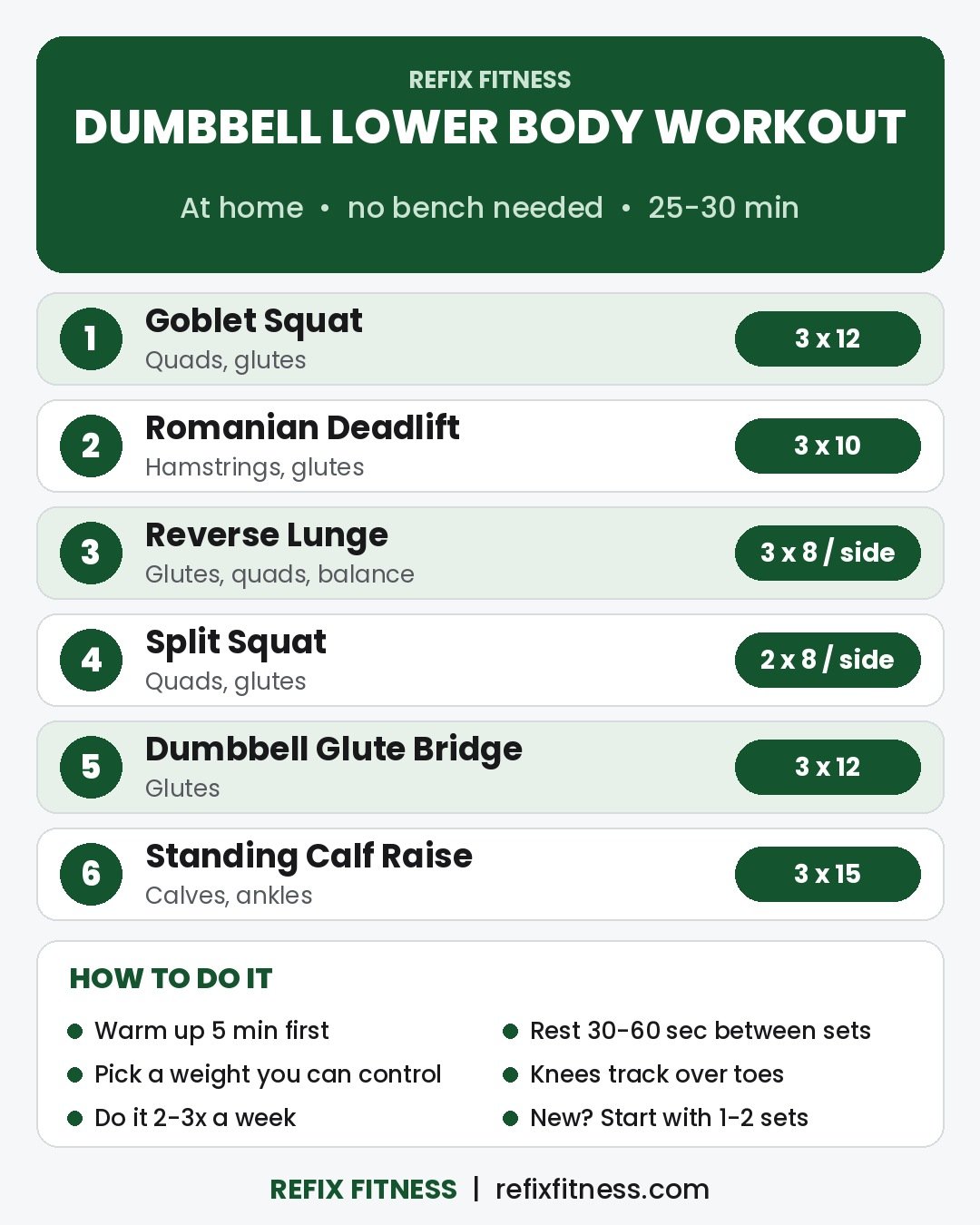
Warm up for about 5 minutes: march in place, then do 10 bodyweight squats, 10 hip hinges and 5 slow reverse lunges per side. Do the moves in order, finishing all sets of one move before the next. Rest 30-60 seconds between sets. If you’re new to weights, do 1-2 sets of each move for the first week or two.
| # | Exercise | Sets x Reps | Main Focus |
|---|---|---|---|
| 1 | Goblet Squat | 3 x 12 | Quads, glutes |
| 2 | Romanian Deadlift | 3 x 10 | Hamstrings, glutes |
| 3 | Reverse Lunge | 3 x 8 per side | Glutes, quads, balance |
| 4 | Split Squat | 2 x 8 per side | Quads, glutes |
| 5 | Dumbbell Glute Bridge | 3 x 12 | Glutes |
| 6 | Standing Calf Raise | 3 x 15 | Calves, ankles |
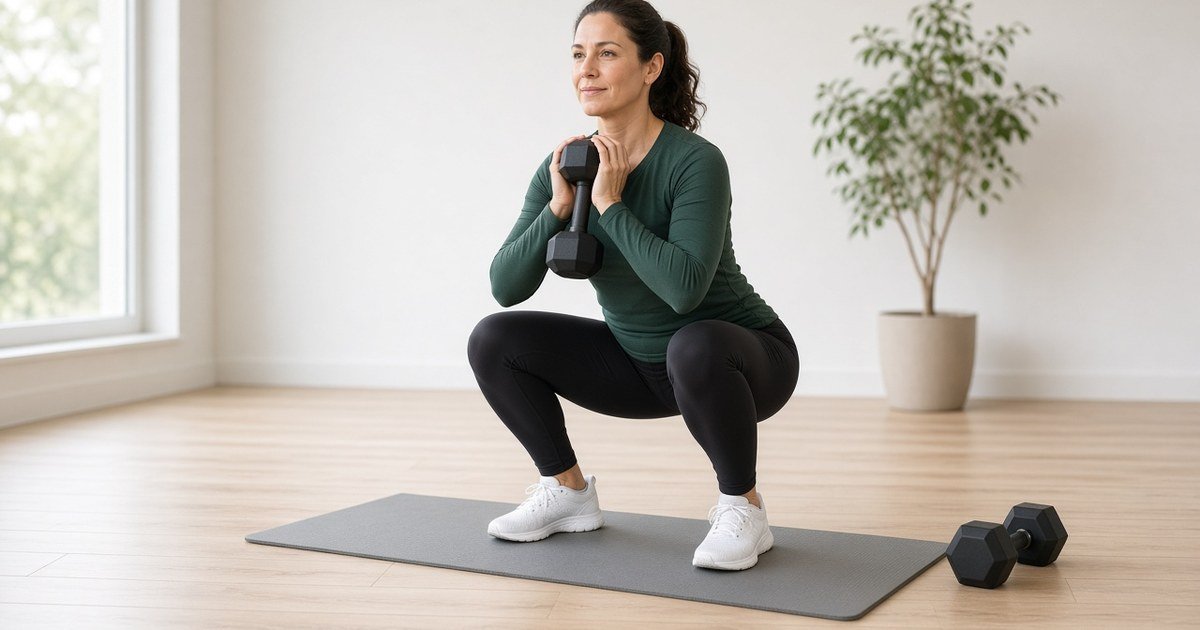
1. Goblet Squat
Holding the weight at your chest helps you stay upright, making this a friendly first loaded squat.
- Hold one dumbbell vertically against your chest, cupping the top end with both hands. Stand with your feet about shoulder-width apart, toes turned out slightly.
- Brace your stomach gently, then sit your hips back and down between your heels, keeping your chest up.
- Lower until your thighs are about parallel to the floor, or as low as you can with your heels flat.
- Press through your whole foot to stand back up.
Form cues: knees track in line with your toes, elbows stay close to your body, and the dumbbell stays touching your chest.
Easier: squat down to a chair and stand back up (box squat), or use a lighter dumbbell. Harder: take 3 seconds to lower, or pause for 2 seconds at the bottom.
2. Romanian Deadlift
The best no-bench move for the back of your legs. It’s a hip hinge, not a squat.
- Stand with your feet hip-width apart, a dumbbell in each hand in front of your thighs, palms facing you.
- Soften your knees slightly, then push your hips straight back, letting the dumbbells slide down the front of your legs.
- Lower until you feel a stretch in the back of your thighs, usually around knee to mid-shin height, while keeping your back flat.
- Squeeze your glutes and drive your hips forward to stand tall.
Form cues: think “hips back,” not “chest down.” Keep the dumbbells close to your legs and stop before your back starts to round.
Easier: hold one dumbbell with both hands, or practice the hinge with no weight. Harder: use a staggered stance with most of your weight on the front leg, or lower over 3-4 seconds.
3. Reverse Lunge
Stepping backward is usually easier on the knees and easier to balance than a forward lunge.
- Stand tall with a dumbbell in each hand at your sides.
- Take a long step back with one foot and lower until both knees are bent to roughly 90 degrees, back knee hovering just above the floor.
- Push through the front heel to bring your back foot forward and stand up.
- Do all reps on one side, then switch.
Form cues: keep most of your weight in the front foot, your torso tall or leaning slightly forward, and your front knee in line with your toes.
Easier: lunge without weights, hold a chair or wall with one hand, or shorten the range. Harder: hold one dumbbell at your chest in the goblet position, or add a 2-second pause at the bottom.
4. Split Squat
The no-bench stand-in for the Bulgarian split squat. Your feet stay put, so you can focus on the working leg.
- From standing, take a long step back so you’re in a staggered stance, back heel lifted. Hold a dumbbell in each hand at your sides.
- Lower straight down, bending both knees, until your back knee is just above the floor.
- Press through your front foot to rise, but don’t fully lock the front knee.
- Finish all reps, then switch legs.
Form cues: move straight up and down like an elevator, and keep your feet hip-width apart side to side, like train tracks, not a tightrope.
Easier: use no weight and lightly hold a chair for balance. Harder: raise your front foot on a thick book or a sturdy step, or take 3 seconds to lower.
5. Dumbbell Glute Bridge
A floor version of the hip thrust, no bench required.
- Lie on your back on the mat with your knees bent and feet flat, about hip-width apart, heels a few inches from your bottom.
- Place one dumbbell across your hip bones and hold it steady with both hands. A folded towel underneath makes it more comfortable.
- Press through your heels and squeeze your glutes to lift your hips until your body forms a straight line from shoulders to knees.
- Hold for 1 second at the top, then lower slowly.
Form cues: keep your ribs down and chin slightly tucked so the lift comes from your hips, not an arched lower back.
Easier: do it without a weight. Harder: pause for 3 seconds at the top, or do a single-leg bridge with the dumbbell held on the working-side hip.
6. Standing Calf Raise
Calves often get skipped at home, but they help with walking and stairs.
- Stand tall with a dumbbell in one or both hands, feet hip-width apart. Rest a fingertip on a wall or chair for balance if needed.
- Rise up onto the balls of your feet as high as you can.
- Pause for 1 second, then lower your heels slowly to the floor.
Form cues: keep your weight over your big toes, not rolling outward, and your knees straight but not locked.
Easier: do it with no weight. Harder: do one leg at a time, or stand with the balls of your feet on a sturdy step so your heels can drop lower.
Sample Weekly Plan
Here’s a simple week that leaves at least one rest day between leg sessions:
- Monday: dumbbell lower body workout
- Tuesday: upper body workout, such as our 5 lb dumbbell arm workout for women
- Wednesday: brisk walk, 20-30 minutes
- Thursday: dumbbell lower body workout
- Friday: core workout or easy bike ride
- Saturday: optional full-body session, such as our dumbbell workout for women over 40 at home, or a long walk
- Sunday: rest
How to progress: when every set feels easy with good form, change one thing at a time: add 2 reps, add a third set to moves 4 and 6, slow the lowering, add a pause, or use slightly heavier dumbbells. The NHS physical activity guidelines give a useful effort target: do strength exercises to the point where you need a short rest before you could repeat them.
Common Mistakes to Avoid
- Squatting during the Romanian deadlift. If your knees bend a lot and your hips drop, it turns into a squat. Push your hips back and keep your shins fairly vertical.
- Rounding your back to reach lower. Depth only counts if your back stays flat. Stop where you feel a hamstring stretch.
- Letting knees cave inward. In squats and lunges, keep your knees tracking over your toes.
- Rushing. Control the way down.
- Holding your breath. Breathe in as you lower and breathe out as you push up.
Safety Tips
- Check with your doctor first if you haven’t exercised in a while, are pregnant or recently gave birth, or have a heart condition, high blood pressure, or a back, hip, knee or ankle problem.
- Clear the space so you can step back for lunges without tripping.
- Handle dumbbells carefully. Set them down gently and check that adjustable dumbbells are locked before each set.
- Stop if something feels wrong. Sharp pain in your knee, hip or lower back, dizziness or chest discomfort are signs to stop, and get medical advice if they don’t settle.
If you have knee or balance concerns, a chair-supported routine like our lower body workout for beginners over 50 at home may be a better starting point.
FAQ
Can you build leg strength with just dumbbells at home?
Yes, for most everyday exercisers. Squats, hinges, lunges and bridges with dumbbells cover the main lower body muscles, and single-leg moves, slower tempos and pauses keep the work challenging as you get stronger.
What can I use instead of a bench for leg exercises?
This plan doesn’t need one: split squats replace Bulgarian split squats, and floor glute bridges replace bench hip thrusts. For a harder variation, a sturdy step or the bottom stair can work if it can’t slide or tip.
Can I do this workout with only one dumbbell?
Yes. Hold it at your chest for squats, lunges and split squats, with both hands in front of you for Romanian deadlifts, across your hips for bridges, and in one hand for calf raises while the other hand holds a wall.
How often should I do a dumbbell lower body workout?
Two to three times a week on non-consecutive days is a good starting point. That fits the common guideline of muscle-strengthening activity on at least 2 days a week and gives your legs time to recover.
Is this workout good for beginners?
Yes, if you start with light dumbbells and 1-2 sets. If squats and lunges are new to you, practice them without weights for a week or two first.
Disclaimer: This article is for general information only and is not medical advice or a substitute for advice, diagnosis, or treatment from a qualified doctor. Please talk to a healthcare professional before starting a new exercise program, especially if you have a health condition, and read our full disclaimer.
Disclaimer: This article is for general information only and is not a substitute for advice, diagnosis or treatment from a qualified doctor. Please talk to a healthcare professional before changing your diet, exercise or medicines, especially if you are pregnant, breastfeeding or have a health condition, and read our full disclaimer.