

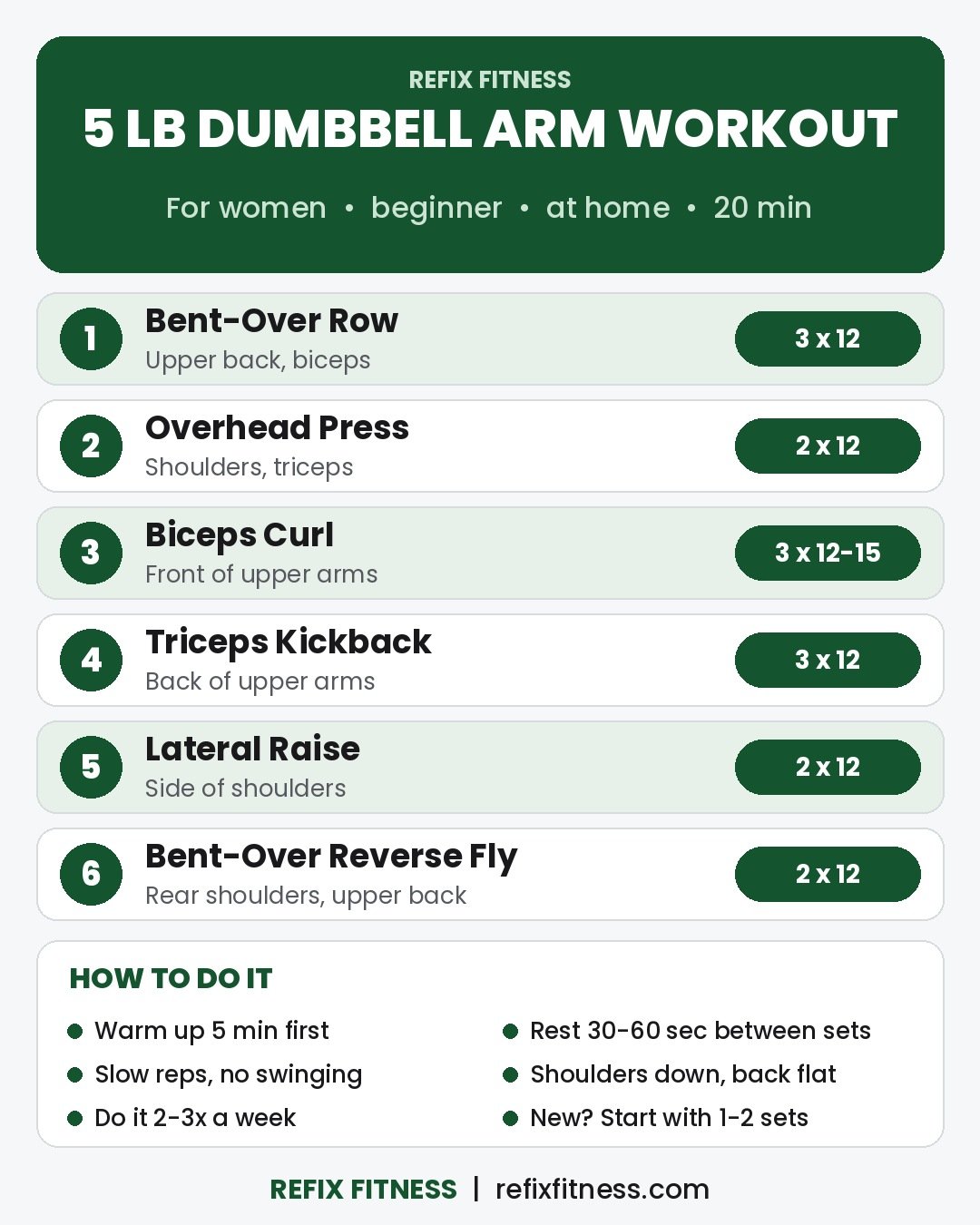
Quick answer: A 5 lb dumbbell arm workout for women can be done at home in about 20 minutes with one pair of light dumbbells. This beginner plan uses 6 moves: bent-over row, overhead press, biceps curl, triceps kickback, lateral raise and bent-over reverse fly. Do 2-3 sets of 12-15 slow, controlled reps of each, rest 30-60 seconds between sets, and repeat the workout 2-3 times a week on non-consecutive days.
It’s written for women who are new to weights, or returning after a break. Below you’ll find the plan, form cues, easier and harder options, a sample week, common mistakes and FAQs.
Why Start With 5 lb Dumbbells?
Five-pound dumbbells are a common starting point: light enough to learn good form, but enough to challenge smaller muscles like the shoulders, biceps and triceps. They’re also quiet and easy to store.
“Light” doesn’t mean “easy.” The goal is for the last 2-3 reps of each set to feel genuinely hard while your form stays clean. The NHS physical activity guidelines put it simply: to get the benefits of strength exercises, do them to the point where you need a short rest before you could repeat them.
Arm work also fits into the bigger picture. The CDC’s adult activity guidelines recommend muscle-strengthening activities on 2 or more days a week that work all the major muscle groups, including the shoulders and arms, alongside at least 150 minutes of moderate aerobic activity such as brisk walking. This routine covers the upper body part of that. Pair it with lower body and core work on other days, or try our full body dumbbell workout for women over 40 at home.
One honest note on “toning”: strength training builds and firms the muscle under the skin, but working one area doesn’t specifically burn the fat over that area. How defined your arms look also depends on your overall activity, eating habits, sleep and genetics. What this workout can do is help your arms and shoulders get stronger for everyday lifting and carrying.
What You’ll Need
- One pair of 5 lb (about 2-2.5 kg) dumbbells. If 5 lb feels too heavy for a move, use 2-3 lb weights or two full water bottles until you’re ready.
- A sturdy chair or bench (optional) for seated presses or a supported row.
- Enough space to stretch your arms out to both sides without hitting anything.
- About 20 minutes, including a 5-minute warm-up.
5 lb Dumbbell Arm Workout for Women: The 6-Move Plan
Warm up for about 5 minutes first: march in place, roll your shoulders forward and back, make slow arm circles in both directions, and do a few reps of each move with no weights. Then do the moves in order, finishing all sets of one move before moving on. Rest 30-60 seconds between sets. If you’re brand new to strength training, start with 1-2 sets of each move for the first week or two.
| # | Exercise | Sets x Reps | Main Focus |
|---|---|---|---|
| 1 | Bent-Over Row | 3 x 12 | Upper back, biceps |
| 2 | Overhead Press | 2 x 12 | Shoulders, triceps |
| 3 | Biceps Curl | 3 x 12-15 | Front of upper arms |
| 4 | Triceps Kickback | 3 x 12 | Back of upper arms |
| 5 | Lateral Raise | 2 x 12 | Side of shoulders |
| 6 | Bent-Over Reverse Fly | 2 x 12 | Rear shoulders, upper back |
1. Bent-Over Row
Works the upper back and biceps together, a good balance for time spent hunched over phones and desks.
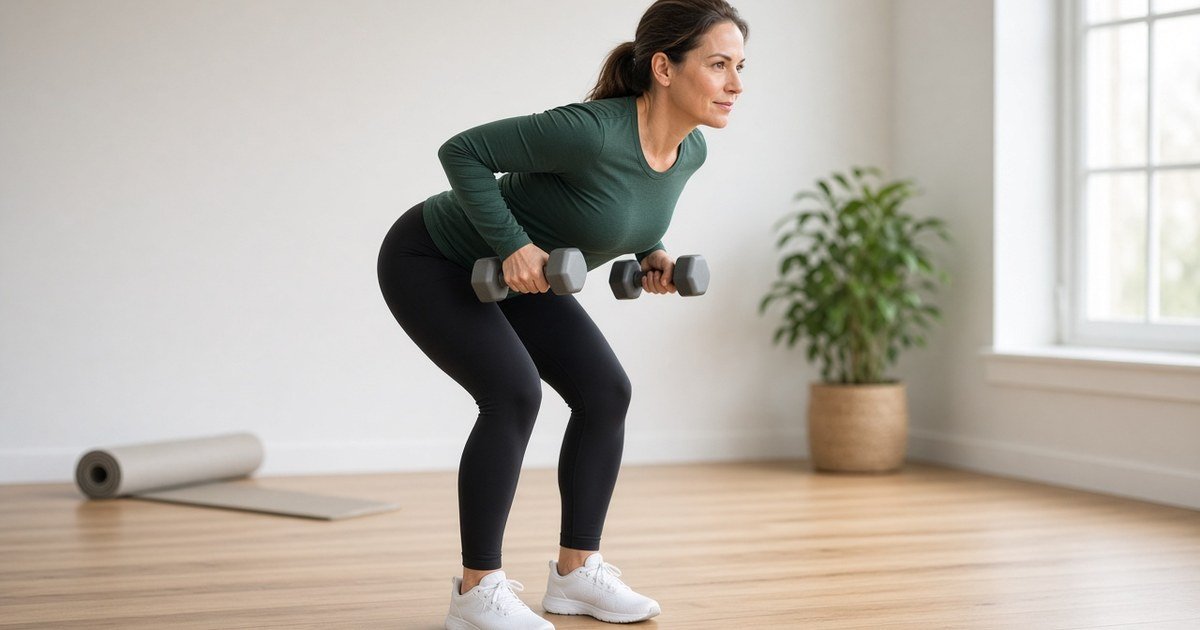
- Stand with your feet hip-width apart, holding a dumbbell in each hand with your palms facing each other.
- Soften your knees and hinge forward from your hips until your upper body is at roughly a 45-degree angle. Let your arms hang straight down.
- Pull both dumbbells up toward the bottom of your ribs, keeping your elbows close to your sides.
- Squeeze your shoulder blades together for 1 second, then lower slowly.
Form cues: keep your back flat and your neck in line with your spine, looking at the floor a little ahead of your feet. Lead with your elbows, not your hands.
Easier: rest one hand on a chair seat and row one arm at a time, which supports your back. Harder: pause for 2 seconds at the top of each rep, or take 3 seconds to lower.
2. Overhead Press
Strengthens the shoulders and triceps for reaching up to high shelves.
- Stand tall (or sit on a chair) with your feet hip-width apart. Hold the dumbbells at shoulder height, palms facing forward or facing each other, elbows just in front of your body.
- Gently brace your stomach.
- Press the dumbbells straight up until your arms are almost straight overhead.
- Lower slowly back to shoulder height.
Form cues: don’t lean back or arch your lower back to get the weights up. Keep your ribs down and your wrists stacked over your elbows.
Easier: do it seated, or press one arm at a time. If raising your arms overhead is uncomfortable, press only to forehead height. Harder: slow down to 3 seconds up and 3 seconds down.
3. Biceps Curl
The classic arm move for the front of the upper arms, used whenever you carry a bag.
- Stand tall with a dumbbell in each hand, arms by your sides and palms facing forward.
- Keep your upper arms still and your elbows close to your ribs.
- Bend your elbows to curl the dumbbells up toward your shoulders.
- Squeeze at the top, then lower slowly until your arms are straight again.
Form cues: no swinging. If your body rocks back to lift the weight, slow down or use a lighter weight. Lower the weights under control rather than letting them drop.
Easier: curl one arm at a time, or sit on a chair. Harder: try hammer curls (palms facing each other) for a second set, or pause halfway down for 2 seconds.
4. Triceps Kickback
Targets the triceps, the muscle along the back of the upper arm.
- Hold a dumbbell in each hand and hinge forward from your hips, the same position as the row.
- Bend your elbows to about 90 degrees and lift your upper arms so they’re close to your sides and roughly parallel to the floor.
- Keeping your upper arms still, straighten your elbows to push the dumbbells back.
- Squeeze for 1 second, then bend your elbows to return.
Form cues: only your forearms should move. If your upper arms drop or swing, the weight may be too heavy for now.
Easier: support yourself with one hand on a chair and work one arm at a time. Harder: hold the straight-arm position for 2-3 seconds on each rep.
5. Lateral Raise
Works the side of the shoulders. 5 lb often feels heaviest here, which is normal.
- Stand tall with a dumbbell in each hand, arms by your sides and palms facing in.
- Keep a slight bend in your elbows.
- Raise your arms out to the sides until your hands reach about shoulder height, or a little lower if that’s more comfortable.
- Lower slowly over about 2-3 seconds.
Form cues: keep your shoulders down and away from your ears. Lead with your elbows, and don’t shrug or swing the weights up.
Easier: raise only halfway, do one arm at a time, or start with no weights. Harder: pause at the top for 2 seconds.
6. Bent-Over Reverse Fly
Trains the back of the shoulders and the muscles between the shoulder blades, which help you stand tall.
- Hinge forward from your hips with soft knees and a flat back, arms hanging down and palms facing each other.
- Keep a slight bend in your elbows.
- Open your arms out to the sides, squeezing your shoulder blades together, until your arms are roughly in line with your shoulders.
- Lower slowly back to the start.
Form cues: think “wide arms, squeeze the back.” Keep your neck relaxed and don’t jerk the weights.
Easier: sit on the edge of a chair and lean forward over your thighs, or use lighter weights. A light resistance band pulled apart in front of your chest also works. See our resistance band workout for women over 50 for that move. Harder: hold the top position for 2 seconds.
Sample Weekly Plan
Aim for 2-3 arm sessions a week with at least one rest day for the upper body between them. Use the other days for walking, lower body or core work:
- Monday: 5 lb dumbbell arm workout, 2 sets of each move
- Tuesday: Brisk walk, 20-30 minutes
- Wednesday: Core work, such as our ab workout for women over 40 at home
- Thursday: 5 lb dumbbell arm workout, full sets
- Friday: Walk, cycle or do a lower body session
- Saturday: 5 lb dumbbell arm workout (optional third session), or a longer walk
- Sunday: Rest
How to progress: when you can do all sets of a move with good form and the last reps no longer feel hard, change one thing at a time. Add a set, slow down the lowering part of each rep, add a short pause, or move up to 8 lb dumbbells for the bigger moves (rows and presses) while keeping 5 lb for lateral raises and reverse flies.
Common Mistakes to Avoid
- Swinging the weights. Slow, controlled reps make light dumbbells feel much harder.
- Shrugging your shoulders. Especially in lateral raises and presses. Keep your shoulders down and your neck long.
- Rounding your back when bent over. In rows, kickbacks and reverse flies, hinge from your hips and keep your back flat. Use the chair-supported option if your lower back gets tired.
- Staying at 5 lb forever. Once 15 reps feel easy, it’s time for a small change, whether that’s more sets, slower reps or a slightly heavier weight.
- Holding your breath. Breathe out as you lift or press, and breathe in as you lower.
Safety Tips
- Check with your doctor first if you haven’t exercised in a while, are pregnant or recently gave birth, or have a heart condition, high blood pressure, osteoporosis, or a shoulder, neck, elbow or wrist injury.
- Work around sore joints. Shorten the range of motion, use lighter weights, or skip any move that causes pain.
- Stop if something feels wrong. Sharp or worsening pain, dizziness, chest discomfort or unusual shortness of breath are signs to stop and get medical advice.
FAQ
Are 5 lb dumbbells heavy enough for women?
For many beginners, yes, at least to start, especially for shoulder moves like lateral raises and reverse flies. The right weight is one where the last 2-3 reps of a set feel hard but your form stays good. If 15 reps feel easy, use a heavier pair for some moves. If you can’t finish 8-10 good reps, go lighter.
Will lifting weights make my arms bulky?
Building a lot of muscle usually takes heavy training, plenty of food and a long time, so a light routine like this is very unlikely to make your arms “bulky.”
How often should I do this arm workout?
Two to three times a week on non-consecutive days is a good start. That matches the common guideline of muscle-strengthening activity on at least 2 days a week and gives your muscles time to recover between sessions.
Can this workout get rid of arm fat?
No workout can target fat in one specific spot. This routine strengthens the muscles of your arms and shoulders. Any change in how your arms look depends on overall habits, including regular activity, eating, sleep and genetics.
How long should a 5 lb dumbbell arm workout take?
About 15-20 minutes for the full plan, plus a 5-minute warm-up. If you’re short on time, do 1 set of each move back to back for a 10-minute version.
Disclaimer: This article is for general information only and is not medical advice or a substitute for advice, diagnosis, or treatment from a qualified doctor. Please talk to a healthcare professional before starting a new exercise program, especially if you have a health condition, and read our full disclaimer.
Disclaimer: This article is for general information only and is not a substitute for advice, diagnosis or treatment from a qualified doctor. Please talk to a healthcare professional before changing your diet, exercise or medicines, especially if you are pregnant, breastfeeding or have a health condition, and read our full disclaimer.