

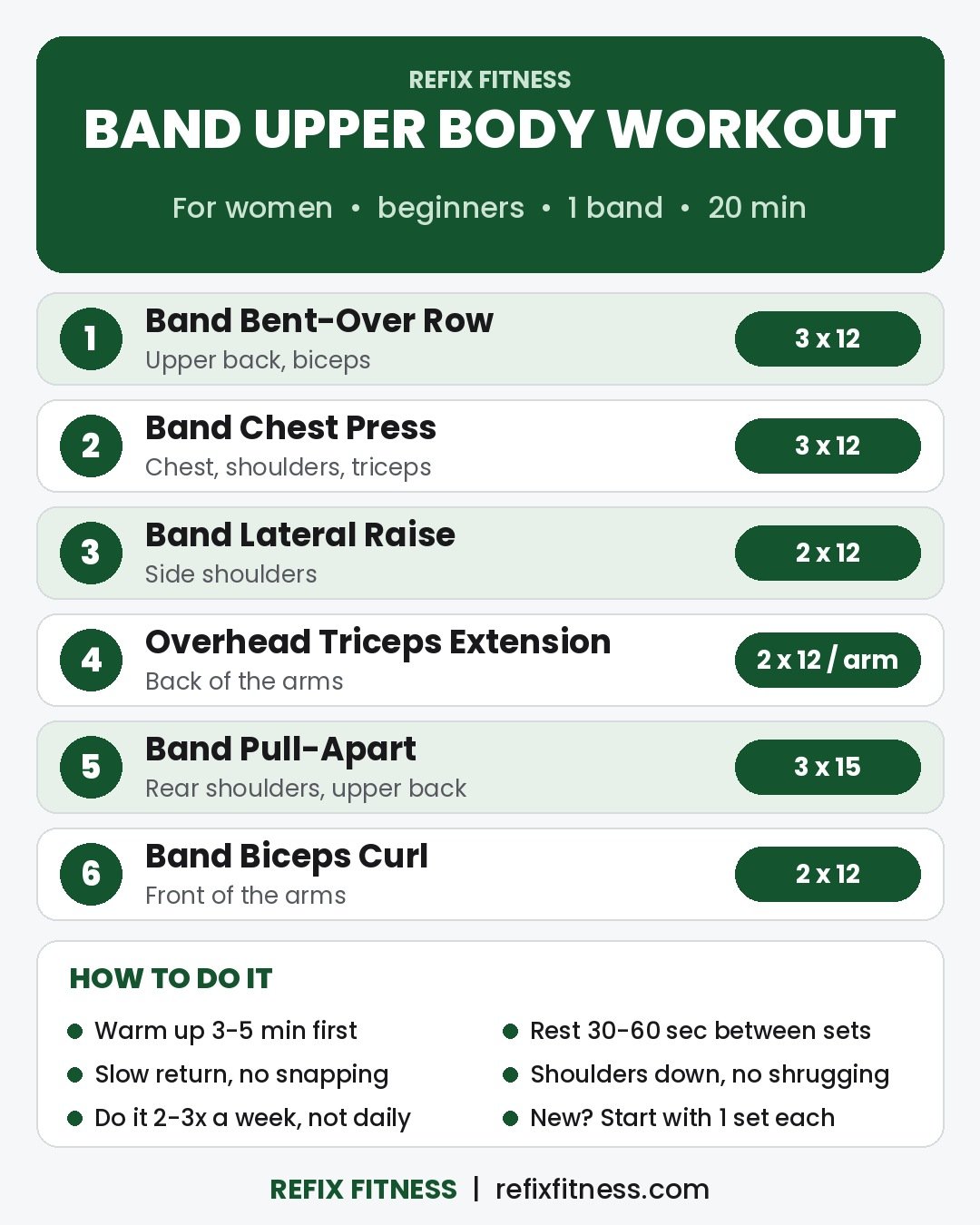
Quick answer: A resistance band upper body workout for women can train your back, chest, shoulders and arms with one inexpensive band and about 20 minutes. This beginner plan uses 6 moves: band bent-over row, band chest press, band lateral raise, overhead triceps extension, band pull-apart and band biceps curl. Do 2-3 sets of each with slow, controlled reps, rest 30-60 seconds between sets, and repeat the workout 2-3 times a week on non-consecutive days.
Why Choose Bands for Upper Body Training?
Bands are a friendly way to start strength training. They are light, cheap, quiet and easy to store, so you can work out in a living room, a bedroom or a hotel room.
Mayo Clinic’s strength training guide lists resistance tubing as a simple home option and suggests choosing a resistance level that tires your muscles after about 12 to 15 repetitions. It also says you may notice stronger muscles if you do strength training at least two times a week for about 20 to 30 minutes each time. That is exactly the kind of routine this article gives you.
If you would rather train with weights, see our upper body dumbbell workout at home with no bench. If you want a full-body band routine for a different age group, try our resistance band workout for women over 50.
What You’ll Need
- One resistance band. A long loop band, a flat band or a tube band with handles all work. If you can only buy one, pick a light-to-medium band. If you can buy two, a lighter one is great for shoulders and a stronger one for rows and presses.
- A little space. You need enough room to stretch your arms out to the sides.
- About 20 minutes, including a short warm-up.
How Do You Choose the Right Band?
Choose a band that lets you finish every rep with good form while the last 2-3 reps feel challenging. If you can race through 20 easy reps, use a stronger band or step farther away from the anchor point. If your shoulders shrug up toward your ears, your back arches or the band snaps back quickly, the band is too strong for that move.
Band Safety Checks
- Inspect the band before each workout for nicks, thin spots or tears. Replace it if you find any.
- Anchor it securely. If you use a door anchor or a post, make sure it can’t slip or pop out.
- Protect your face. Keep a stretched band below eye level.
Resistance Band Upper Body Workout for Women: The 6-Move Plan
Warm up for about 3-5 minutes: march in place, then do 10 slow arm circles forward and back, 10 shoulder rolls and 10 gentle hug-yourself stretches. Then do a few reps of each move with the lightest band or no band. Do the moves in order, finishing all sets of one move before the next. Rest 30-60 seconds between sets. In your first week, 1-2 sets of each move is plenty.
| # | Exercise | Sets x Reps | Main Focus |
|---|---|---|---|
| 1 | Band Bent-Over Row | 3 x 12 | Upper back, biceps |
| 2 | Band Chest Press | 3 x 12 | Chest, shoulders, triceps |
| 3 | Band Lateral Raise | 2 x 12 | Side shoulders |
| 4 | Overhead Triceps Extension | 2 x 12 | Back of the arms |
| 5 | Band Pull-Apart | 3 x 15 | Rear shoulders, upper back |
| 6 | Band Biceps Curl | 2 x 12 | Front of the arms |
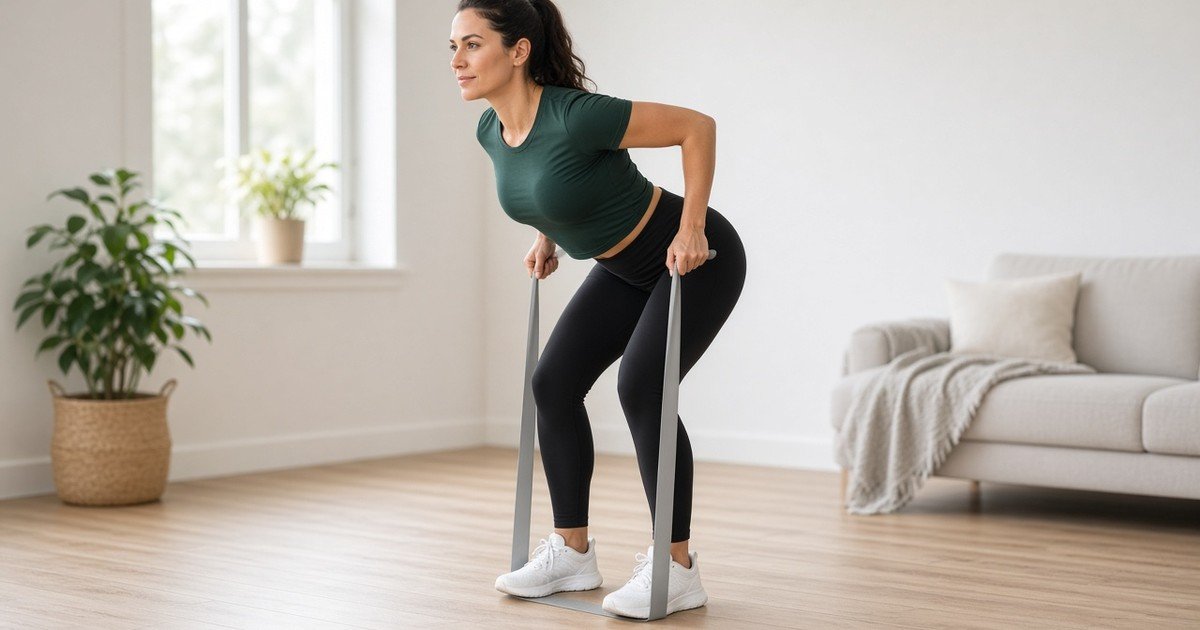
1. Band Bent-Over Row
Works the muscles between and below your shoulder blades, which help you stand tall and pull things toward you.
- Stand on the middle of the band with your feet hip-width apart, holding an end in each hand.
- Soften your knees and hinge forward from your hips until your back is at a comfortable angle, with a long, flat spine and your arms hanging down.
- Pull both elbows back toward your hips, squeezing your shoulder blades together gently.
- Pause for a moment, then slowly straighten your arms to return.
Form cues: keep your neck in line with your spine and your elbows close to your body. Think of pulling your elbows, not your hands.
Easier: sit on a chair with the band looped under your feet, lean slightly forward and row from there. Harder: pause for 2 seconds at the end of each pull, or step wider on the band for more tension.
2. Band Chest Press
Trains your chest, the front of your shoulders and the back of your arms in a pushing motion.
- Wrap the middle of the band across your upper back, just below your shoulder blades, holding an end in each hand.
- Stand with your feet hip-width apart or in a small split stance, with your elbows bent and your hands beside your chest.
- Press both hands straight forward until your arms are almost straight.
- Slowly bring your hands back to your chest.
Form cues: keep your wrists straight, your ribs down and your shoulders away from your ears. Don’t lock your elbows hard at the end.
Easier: use a lighter band or press with a shorter range. Harder: take 3 seconds to bring your hands back, or press one arm at a time.
3. Band Lateral Raise
Strengthens the sides of your shoulders. Use a lighter band here, because your shoulders are smaller than your back and chest.
- Stand on the band with both feet and hold an end in each hand beside your thighs.
- Keep a slight bend in your elbows and lift your arms out to the sides until your hands reach about shoulder height.
- Pause briefly at the top, with your shoulders relaxed.
- Lower your arms slowly, taking about 3 seconds.
Form cues: lead with your elbows, not your hands, and keep your neck relaxed. If you shrug, the band is too strong.
Easier: lift only to about hip height, or use a lighter band. Harder: hold at the top for 2 seconds.
4. Overhead Triceps Extension
Works the muscles on the back of your upper arms by straightening your elbows against the band.
- Stand on one end of the band with your right foot, or hold it down with your hand if you prefer.
- Hold the other end in your right hand, bring that hand up behind your head with your elbow pointing toward the ceiling.
- Keeping your upper arm still, straighten your arm up toward the ceiling.
- Slowly bend your elbow to return. Finish all reps, then switch arms.
Form cues: keep your elbow close to your ear and your ribs down, so your lower back does not arch.
Easier: use a lighter band or shorten the band less. Harder: slow the lowering part to 3-4 seconds. If you have shoulder discomfort overhead, skip this move and add a set of the biceps curl instead.
5. Band Pull-Apart
A classic posture move that works your rear shoulders and upper back, the muscles that often feel tight after hours at a desk or phone.
- Stand tall holding the band in front of you at chest height, hands about shoulder-width apart, arms straight.
- Pull the band apart by moving your hands out to the sides until the band touches or nears your chest.
- Squeeze your shoulder blades gently together.
- Slowly bring your hands back in front of you.
Form cues: keep your arms level with your chest and your chin tucked slightly. Move from your upper back, not by leaning backward.
Easier: hold the band with your hands wider apart so there is less tension. Harder: hold the squeeze for 2 seconds each rep.
6. Band Biceps Curl
Strengthens the front of your upper arms.
- Stand on the middle of the band with your feet hip-width apart. Hold an end in each hand, palms facing forward, arms down by your sides.
- Keep your elbows next to your ribs and curl your hands toward your shoulders.
- Pause at the top without letting your shoulders creep forward.
- Lower slowly until your arms are almost straight.
Form cues: your elbows should stay still. If you swing your body to lift, use a lighter band. For more arm work with weights, see our 5 lb dumbbell arm workout for women.
Easier: do one arm at a time with a shorter band. Harder: take 3 seconds to lower each rep.
Sample Weekly Plan
Do this workout 2-3 times a week on non-consecutive days. Here is one way to fit it around walking and a lower body session:
| Day | What to Do |
|---|---|
| Monday | Band upper body workout |
| Tuesday | Brisk walk, 20-30 minutes |
| Wednesday | Lower body workout |
| Thursday | Brisk walk or gentle stretching |
| Friday | Band upper body workout |
| Saturday | Long walk or bike ride |
| Sunday | Rest |
For the lower body day, our mini band leg workout for beginners uses the same type of equipment.
This lines up with the CDC’s guidance for adults, which says adults need 150 minutes of moderate-intensity physical activity and 2 days of muscle-strengthening activity each week, and that any amount of activity has some health benefits.
How to Progress Over the Weeks
Change one thing at a time:
- Weeks 1-2: 1-2 sets of each move with a light band. Focus on form.
- Weeks 3-4: 2-3 sets of each move, as listed in the plan.
- Weeks 5 and beyond: slow the lowering part of each rep to 3 seconds, add 2-3 reps, or move to a slightly stronger band for the row and chest press.
Mayo Clinic suggests increasing the resistance gradually once you can easily do more repetitions of an exercise, and resting one full day between training the same muscle group.
Common Mistakes to Avoid
- Shrugging your shoulders. This is the most common mistake on lateral raises and presses. Drop your shoulders down and use a lighter band.
- Letting the band snap back. The slow return is half the work. Count to 3 on the way back.
- Arching your lower back. Keep your ribs down and your stomach gently braced on every standing move.
Safety Tips
- Check with your doctor first if you haven’t exercised in a while, are pregnant or recently gave birth, or have shoulder, neck or back problems, high blood pressure, a heart condition or a recent injury or surgery.
- Stop if something feels wrong. Sharp pain, pinching in the shoulder, numbness, dizziness or chest discomfort are signs to stop. Get medical advice if they don’t settle.
FAQ
Can beginners get a good upper body workout with resistance bands?
Yes. Bands let you start with a very light resistance and increase it slowly, which suits beginners. Focus on slow, controlled reps and good form. If a move feels too hard, use a lighter band or the easier option listed above.
How often should I do a resistance band upper body workout?
Two to three times a week on non-consecutive days is a good starting point, giving your muscles a day to recover in between. Two sessions a week is enough to begin with.
Will bands make my arms bulky?
Resistance bands are a light form of strength training, and most beginners notice that they feel stronger and more capable before they notice any visible change. Changes in how your arms look depend on your overall activity, nutrition, sleep and genetics, and results vary from person to person.
Is this workout safe if I have shoulder pain?
Shoulder pain has many causes, so ask a doctor or physical therapist before starting. If you get the all-clear, choose a very light band, use a smaller range and skip any move that causes pain, such as the overhead triceps extension or lateral raise.
Disclaimer: This article is for general information only and is not medical advice or a substitute for advice, diagnosis, or treatment from a qualified doctor. Please talk to a healthcare professional before starting a new exercise program, especially if you have a health condition, and read our full disclaimer.
Disclaimer: This article is for general information only and is not a substitute for advice, diagnosis or treatment from a qualified doctor. Please talk to a healthcare professional before changing your diet, exercise or medicines, especially if you are pregnant, breastfeeding or have a health condition, and read our full disclaimer.