

Quick answer: A dumbbell ab workout for beginners at home can train your whole core with just one light dumbbell and a mat. This plan uses 6 moves: weighted dead bug, Russian twist with feet down, suitcase hold, dumbbell side bend, weighted glute bridge and half-kneeling dumbbell halo. Do 2 sets of each with slow, controlled reps, rest 30-60 seconds between sets, and repeat the workout 2-3 times a week on non-consecutive days. No crunches or sit-ups needed.
Why Use a Dumbbell for Core Training?
Your core includes your stomach muscles, the muscles along your sides (obliques), your lower back, hips and pelvis. In daily life, it mostly keeps your trunk steady while your arms and legs move, like when you carry grocery bags.
One dumbbell trains that job well. Hold it in front of you, and your core resists arching. Hold it on one side, and your core resists tipping. Mayo Clinic’s guide to core exercises notes that using free weights while keeping your core stable trains many of your muscles, including your core, and that core exercises don’t need a gym membership.
If you’d rather start with no equipment at all, our ab workout for women over 40 at home uses bodyweight versions of several of these moves.
What You’ll Need
- One light dumbbell. A single dumbbell is enough for every move.
- A mat or carpet for the floor moves and the half-kneeling halo.
- About 15 minutes, including a short warm-up.
How Heavy Should Your Dumbbell Be?
Lighter than you think. Choose a weight you can move slowly for every rep while keeping your back in a steady position, where the last 2-3 reps feel challenging. If your lower back arches, your shoulders shrug or you start swinging, the dumbbell is too heavy.
Only own one dumbbell? Adjust each move with speed, range and holds instead. A filled water bottle also works for learning the moves.
Dumbbell Ab Workout for Beginners at Home: The 6-Move Plan
Warm up for about 3-5 minutes: march in place, then do 10 slow hip circles each way, 10 cat-cow stretches on your hands and knees, and a few reps of each move with no weight. Do the moves in order, finishing both sets of one move before the next. Rest 30-60 seconds between sets. In your first week, 1 set of each move is plenty.
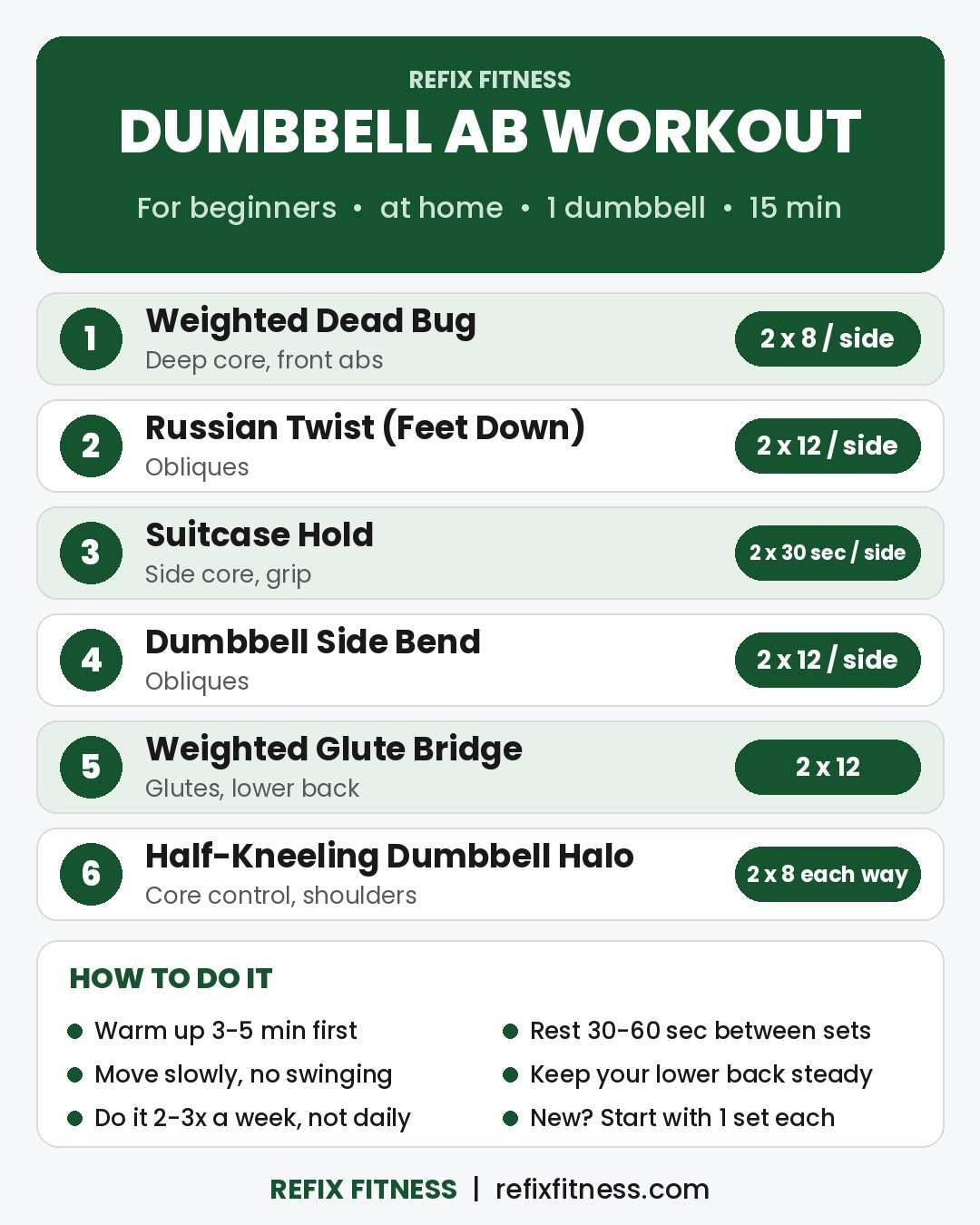
| # | Exercise | Sets x Reps | Main Focus |
|---|---|---|---|
| 1 | Weighted Dead Bug | 2 x 8 per side | Deep core, front abs |
| 2 | Russian Twist (Feet Down) | 2 x 12 per side | Obliques |
| 3 | Suitcase Hold | 2 x 30 sec per side | Side core, grip |
| 4 | Dumbbell Side Bend | 2 x 12 per side | Obliques |
| 5 | Weighted Glute Bridge | 2 x 12 | Glutes, lower back |
| 6 | Half-Kneeling Dumbbell Halo | 2 x 8 each direction | Core control, shoulders |
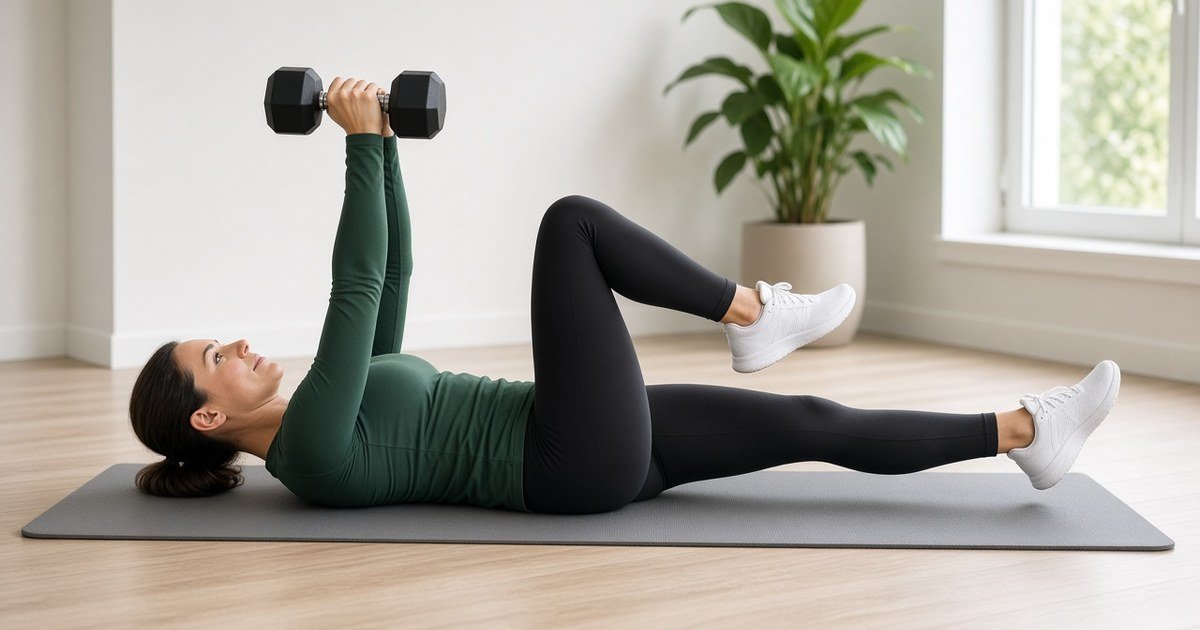
1. Weighted Dead Bug
Teaches you to brace your stomach and keep your lower back steady while your limbs move.
- Lie on your back holding one dumbbell with both hands, arms straight up over your chest.
- Lift your legs so your knees are bent at about 90 degrees, stacked over your hips.
- Gently press your lower back toward the mat and breathe out to brace your stomach.
- Slowly straighten one leg and lower it toward the floor, stopping before your back starts to arch. Return it, then switch legs. That’s one rep per side.
Form cues: keep the dumbbell still over your chest and move slowly. If your lower back lifts off the mat, shorten how far your leg goes.
Easier: keep your knee bent and just tap your heel to the floor, or do it with no weight. Harder: lower the opposite leg while you slowly move the dumbbell back over your head, then return both together.
2. Russian Twist (Feet Down)
Works your obliques through slow rotation. Feet on the floor keeps it steadier than the feet-up version.
- Sit on the mat with your knees bent and feet flat. Hold the dumbbell with both hands close to your chest.
- Sit tall, then lean back slightly until you feel your stomach switch on. Keep your chest lifted.
- Turn your ribs and shoulders to the right, bringing the dumbbell beside your right hip.
- Return to the center, then turn to the left. Each turn counts as one rep for that side.
Form cues: rotate from your ribcage, not just your arms, and keep your spine long rather than slumping.
Easier: sit more upright, or hold the dumbbell closer to your chest. Harder: pause for 1-2 seconds at each side, or hold the dumbbell a little farther from your body.
If twisting bothers your back, swap this for an extra suitcase hold set.
3. Suitcase Hold
Holding weight on one side makes the opposite side of your trunk work to keep you upright.
- Stand tall with your feet hip-width apart, holding the dumbbell at your right side with your arm straight.
- Pull your shoulders down and back, and brace your stomach as if someone is about to poke it.
- Hold for 30 seconds without leaning toward the dumbbell or away from it. Breathe normally.
- Switch hands and repeat on the other side.
Form cues: imagine you’re standing between two panes of glass. Your shoulders and hips should stay level.
Easier: hold for 15-20 seconds. Harder: turn it into a suitcase carry by walking slowly around the room, or use a heavier dumbbell.
4. Dumbbell Side Bend
Works your obliques by bending sideways against the dumbbell’s weight, then pulling yourself back up.
- Stand tall holding the dumbbell in your right hand, with your left hand resting on your hip.
- Slowly bend to the right, sliding the dumbbell down the side of your thigh. Go only as far as feels comfortable.
- Use the muscles on your left side to pull yourself back to standing.
- Finish all reps, then switch sides.
Form cues: bend straight to the side without leaning forward or twisting, and hold only one dumbbell at a time. Holding one in each hand cancels out the work.
Easier: make the movement smaller, or use a lighter dumbbell. Harder: take 3 seconds to come back up, or pause at the bottom.
5. Weighted Glute Bridge
Trains the back of your core: your glutes and lower back, which work with your abs to support your spine.
- Lie on your back with your knees bent and feet flat, about hip-width apart.
- Rest the dumbbell across your hips and hold it in place with both hands.
- Tighten your stomach, then press through your heels to lift your hips until your shoulders, hips and knees form a straight line.
- Squeeze your glutes at the top for a moment, then lower slowly.
Form cues: keep your ribs down and finish the lift with your glutes, not by arching your lower back.
Easier: do it without the dumbbell. Harder: hold the top for 3 seconds on each rep. For more bridge and hip work with dumbbells, see our dumbbell lower body workout at home with no bench.
6. Half-Kneeling Dumbbell Halo
You circle the dumbbell around your head while your core keeps your trunk still.
- Kneel on your right knee on the mat, with your left foot flat in front of you and both knees bent at about 90 degrees.
- Hold the dumbbell upright by its ends in front of your chest.
- Slowly circle it around your head: past one ear, behind your head, past the other ear and back to your chest. That’s one rep.
- Do all reps in one direction, then reverse. On your second set, switch which knee is down.
Form cues: keep your ribs down and your hips still. Only your arms should move, and the dumbbell should stay close to your head.
Easier: do it standing, or sitting tall on a chair, with a lighter weight. Harder: move more slowly, taking about 4 seconds per circle.
Sample Weekly Plan
Do this workout 2-3 times a week on non-consecutive days, on its own or as a finisher after another session:
| Day | What to Do |
|---|---|
| Monday | Upper body workout + dumbbell ab workout |
| Tuesday | Brisk walk, 20-30 minutes |
| Wednesday | Lower body workout |
| Thursday | Dumbbell ab workout + brisk walk |
| Friday | Rest or gentle stretching |
| Saturday | Full body workout + dumbbell ab workout |
| Sunday | Rest |
This lines up with the NHS physical activity guidelines for adults, which recommend strengthening activities that work all the major muscle groups, including the abdomen, back and hips, on at least 2 days a week, plus at least 150 minutes of moderate activity such as brisk walking. For the upper body day, try our upper body dumbbell workout at home with no bench.
How to Progress Over the Weeks
Change one thing at a time. Build from 1 set to 2, and later 3. When a move feels easy, add 2 reps per side, add 10 seconds to the hold, slow down, or try the harder option. Go heavier only when every rep stays steady.
Common Mistakes to Avoid
- Arching your lower back on the dead bug. Lower your leg only as far as you can while your back stays in place.
- Swinging the dumbbell on twists. Slow, controlled turns work your obliques. Fast swings mostly add momentum.
- Leaning during the suitcase hold. If you can’t stand straight, use a lighter dumbbell or hold for less time.
- Holding your breath. Breathe out during the hardest part of each move, and keep breathing steadily during holds.
- Expecting abs to burn belly fat. Core work strengthens the muscles underneath, but it doesn’t target fat in one spot.
Safety Tips
- Check with your doctor first if you haven’t exercised in a while, are pregnant or recently gave birth, or have back pain, a hernia, abdominal separation, high blood pressure, a heart condition or a recent surgery.
- Control the weight near your face. On the dead bug and halo, use a dumbbell you can hold securely, and move slowly.
- Stop if something feels wrong. Sharp pain in your back, hips or stomach, dizziness or chest discomfort are signs to stop, and get medical advice if they don’t settle.
FAQ
Can beginners do ab workouts with dumbbells?
Yes, as long as you start light and focus on control. Moves like the weighted dead bug, suitcase hold and glute bridge let you add a little load while keeping your spine in a steady position. If a move feels too hard, use the easier option or do it without weight first.
How often should I do a dumbbell ab workout at home?
Two to three times a week on non-consecutive days is a good starting point. That gives your core time to recover.
Do I need two dumbbells for this workout?
No. Every move in this plan uses one dumbbell. For the side bend, holding only one dumbbell is actually the point, because the weight on one side is what makes your obliques work.
Is this workout safe if I have lower back pain?
Some people find gentle core work helpful, but back pain has many causes, so ask a doctor or physical therapist before starting. If any move increases your pain, stop that move. The Russian twist is the one to skip first if twisting feels uncomfortable.
Will a dumbbell ab workout give me a flat stomach?
You can’t choose where your body loses fat. Core exercises can strengthen and tone the muscles under your stomach, but changes in belly fat depend on your overall activity, eating habits, sleep and other factors, and results vary from person to person.
Disclaimer: This article is for general information only and is not medical advice or a substitute for advice, diagnosis, or treatment from a qualified doctor. Please talk to a healthcare professional before starting a new exercise program, especially if you have a health condition, and read our full disclaimer.
Disclaimer: This article is for general information only and is not a substitute for advice, diagnosis or treatment from a qualified doctor. Please talk to a healthcare professional before changing your diet, exercise or medicines, especially if you are pregnant, breastfeeding or have a health condition, and read our full disclaimer.