

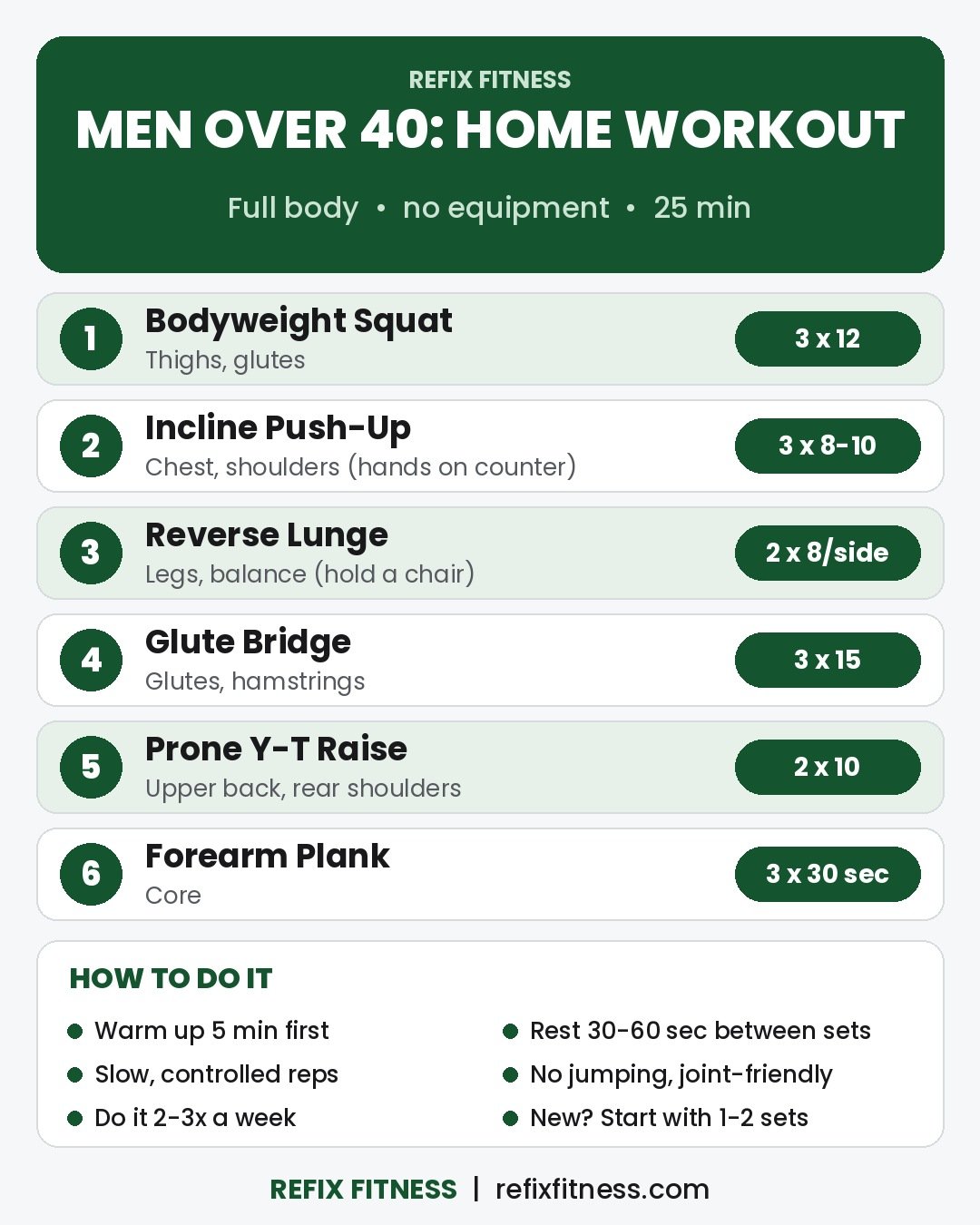
Quick answer: A simple bodyweight workout for men over 40 at home needs no equipment, just a mat, a wall or kitchen counter, and about 25 minutes. This full-body plan uses 6 joint-friendly moves: bodyweight squat, incline push-up, reverse lunge, glute bridge, prone Y-T raise and forearm plank. Do 2-3 sets of each, rest 30-60 seconds between sets, and repeat the workout 2-3 times a week on non-consecutive days.
It’s built for men who are getting back into training after a few years off, or starting for the first time. Below you’ll find the plan, form cues for every move, easier and harder options, a sample week, common mistakes and FAQs.
Why a Bodyweight Routine Makes Sense After 40
After 40, work, family and old injuries often push exercise down the list. A short routine in the living room removes most excuses, and bodyweight training is easy to adjust. You can make a push-up easier by putting your hands on a wall or harder by lowering your hands to a chair. You can shorten a squat if your knees complain or slow it down if it feels too easy.
Health guidelines back up the idea of regular strength work. The CDC’s adult activity guidelines recommend muscle-strengthening activities on 2 or more days a week that work all the major muscle groups (legs, hips, back, abdomen, chest, shoulders and arms), along with at least 150 minutes of moderate aerobic activity such as brisk walking. The NHS physical activity guidelines give the same 2-day target and list exercises that use your own body weight, such as push-ups, as one way to do it.
The 6 moves below cover all of those areas in one session: legs and hips (squat, lunge, bridge), chest, shoulders and arms (incline push-up), upper back (Y-T raise) and core (plank).
What You’ll Need
- A mat, rug or carpet for the floor moves.
- A wall, kitchen counter or sturdy table for incline push-ups.
- About 25 minutes, including a 5-minute warm-up.
Bodyweight Workout for Men Over 40 at Home: The 6-Move Plan
Warm up for about 5 minutes first: march in place or walk around the house, roll your shoulders forward and back, swing your arms across your chest, and do a few slow half squats. Then do the moves in order, finishing all sets of one move (resting 30-60 seconds between sets) before moving on. If you haven’t trained in a long time, do 1-2 sets of each move for the first couple of weeks.
| # | Exercise | Sets x Reps | Main Focus |
|---|---|---|---|
| 1 | Bodyweight Squat | 3 x 12 | Thighs, glutes |
| 2 | Incline Push-Up | 3 x 8-10 | Chest, shoulders, triceps |
| 3 | Reverse Lunge | 2 x 8 per side | Legs, glutes, balance |
| 4 | Glute Bridge | 3 x 15 | Glutes, hamstrings |
| 5 | Prone Y-T Raise | 2 x 10 | Upper back, rear shoulders |
| 6 | Forearm Plank | 3 x 30 sec | Core |
1. Bodyweight Squat
Trains the pattern you use every time you sit down and stand up.
- Stand with your feet about shoulder-width apart, toes turned out slightly.
- Brace your stomach lightly and reach your arms forward for balance.
- Push your hips back and bend your knees to sit down, as if aiming for a chair behind you.
- Go as low as you can while keeping your heels down and your back flat, then push through your whole foot to stand up.
Form cues: keep your knees tracking in line with your toes, not caving in. Keep your chest up, but don’t arch your lower back.
Easier: squat down to a chair, lightly touch it, and stand back up (a box squat). Harder: take 3 seconds to lower, or pause for 2 seconds at the bottom of each rep.
2. Incline Push-Up
A push-up with your hands raised on a wall, counter or table. The higher your hands, the easier it gets.
- Place your hands on a counter or sturdy table edge, a little wider than shoulder-width.
- Walk your feet back until your body forms a straight line from head to heels.
- Bend your elbows and lower your chest toward the edge, keeping your elbows at roughly 45 degrees from your body rather than flared straight out.
- Push the surface away to straighten your arms, keeping your body in one straight line.
Form cues: squeeze your glutes and brace your stomach so your hips don’t sag. Lead with your chest, not your chin.
Easier: do the push-up against a wall. Harder: use a lower surface, such as a sturdy chair seat or a step, and work toward a regular push-up on the floor.
3. Reverse Lunge
Stepping back is usually easier to control than stepping forward, which makes it a good single-leg move for knees that have seen some miles.
- Stand tall next to a chair or wall and rest one hand on it if you need balance.
- Step your right foot back and lower your back knee toward the floor, bending both knees.
- Go only as low as feels comfortable, with most of your weight on your front foot.
- Push through your front heel to stand back up. Do all reps on one side, then switch.
Form cues: keep your front knee pointing the same way as your toes and your front heel flat on the floor.
Easier: take a shorter step and lower only a few inches, or swap in a split squat where your feet stay in place. Harder: let go of the support, or pause for 2 seconds at the bottom of each rep.
4. Glute Bridge
Trains the glutes and hamstrings, which many desk-bound men find hard to switch on.
- Lie on your back with your knees bent, feet flat on the floor and hip-width apart.
- Gently brace your stomach so your ribs stay down.
- Press through your heels and squeeze your glutes to lift your hips until your shoulders, hips and knees form a straight line.
- Pause for 1-2 seconds at the top, then lower slowly.
Form cues: stop when your body is in a straight line and don’t arch your lower back. If you feel it mostly in your hamstrings, move your feet a little closer to your hips. For a full glute-focused session, see our bodyweight glute workout for beginners at home.
Easier: do fewer reps with a smaller lift. Harder: hold the top for 3-5 seconds, or try a single-leg bridge with one foot lifted.
5. Prone Y-T Raise
The upper back is the hardest area to train at home without a pull-up bar. This move fills that gap.
- Lie face down on a mat with your forehead resting on a small folded towel and your arms stretched overhead in a “Y” shape, thumbs pointing up.
- Squeeze your shoulder blades back and down and lift your arms a few inches off the floor. Hold for 1-2 seconds, then lower.
- Move your arms straight out to the sides to make a “T,” thumbs up, and repeat the same lift and lower.
- One “Y” plus one “T” counts as 1 rep.
Form cues: the lift is small. Keep your neck long and your eyes on the floor, and don’t lift your chest high off the mat by arching your lower back.
Easier: do only the “T” position, or bend your elbows to shorten the lever. Harder: hold each lift for 3 seconds, or add a “W” (elbows bent, pulled toward your sides) as a third position.
6. Forearm Plank
A steady hold that trains your core to keep your trunk still.
- Lie face down and place your elbows directly under your shoulders, forearms on the floor.
- Tuck your toes, brace your stomach and squeeze your glutes.
- Lift your body so it forms a straight line from head to heels.
- Hold for up to 30 seconds while breathing steadily, then lower with control.
Form cues: don’t let your hips sag or pike up. Push the floor away with your forearms so your upper back doesn’t collapse. Stop the set when your form starts to break, even if the timer hasn’t finished.
Easier: plank on your knees, or do it with your forearms on a bench or table. Harder: hold for 40-45 seconds, or slowly lift one foot at a time a few inches off the floor.
Sample Weekly Plan
Aim for 2-3 strength sessions a week with at least one rest or easy day between them. Add walking on the other days to work toward the 150-minute aerobic target:
- Monday: Full-body bodyweight workout, 2 sets of each move
- Tuesday: Brisk walk, 20-30 minutes
- Wednesday: Full-body bodyweight workout, full sets
- Thursday: Walk, plus 10 minutes of gentle stretching
- Friday: Full-body bodyweight workout, full sets
- Saturday: Longer walk, bike ride, or our low-impact fat burning workout at home with no jumping
- Sunday: Rest
How to progress: when every set feels controlled and the last couple of reps are no longer a challenge, change one thing at a time. Add 2 reps, add a set, slow down the lowering part of each rep, or move to the harder option for one exercise. Energy, sleep and daily habits matter too; our guide to natural ways to improve stamina and energy in men covers the basics.
Common Mistakes to Avoid
- Going too hard in week one. Many men restart with the same intensity they used at 25. Start with fewer sets and leave a couple of reps in the tank.
- Sagging hips in push-ups and planks. Squeeze your glutes and brace your stomach to keep a straight line. Raise your hands higher if you can’t hold it.
- Letting the knees cave in. In squats and lunges, keep your knees in line with your toes.
- Holding your breath. Breathe out as you push or stand up, and breathe in as you lower.
Safety Tips
- Check with your doctor first if you haven’t exercised in a while, or if you have a heart condition, high blood pressure, diabetes, back, shoulder, hip or knee problems, or a recent injury or surgery.
- Work around old injuries. Use the easier options, shorten the range of motion, or skip a move that causes pain. The NHS also has gentle, chair-supported strength exercises if you need an even easier start.
- Stop if something hurts. Sharp pain, joint pain, dizziness, unusual shortness of breath or chest discomfort are signs to stop and get medical advice.
FAQ
Can men over 40 build strength with bodyweight exercises only?
Yes, especially when you’re starting out or returning after a break. To keep progressing, you’ll need to make them harder over time with more reps, more sets, slower reps, pauses or harder variations.
How often should I do this home workout?
Two to three times a week on non-consecutive days is a good start. That meets the common guideline of muscle-strengthening activity on at least 2 days a week and leaves time to recover between sessions.
Is this workout OK if I have bad knees?
Many people with sensitive knees can do it with changes. Squat to a chair, keep lunges short or swap them for extra glute bridges, and avoid any move that causes pain. If you have a diagnosed knee condition, ask your doctor or a physical therapist first.
Do I need cardio as well?
This routine is mainly strength training. Health guidelines also recommend regular aerobic activity, such as brisk walking, on top of strength work. A daily walk is an easy way to cover it.
How long until I see results?
It varies from person to person and depends on how often you train, how you progress, what you eat, how well you sleep and your starting point. Many men notice the workout feeling easier before they see changes in the mirror.
Disclaimer: This article is for general information only and is not medical advice or a substitute for advice, diagnosis, or treatment from a qualified doctor. Please talk to a healthcare professional before starting a new exercise program, especially if you have a health condition, and read our full disclaimer.
Disclaimer: This article is for general information only and is not a substitute for advice, diagnosis or treatment from a qualified doctor. Please talk to a healthcare professional before changing your diet, exercise or medicines, especially if you are pregnant, breastfeeding or have a health condition, and read our full disclaimer.