

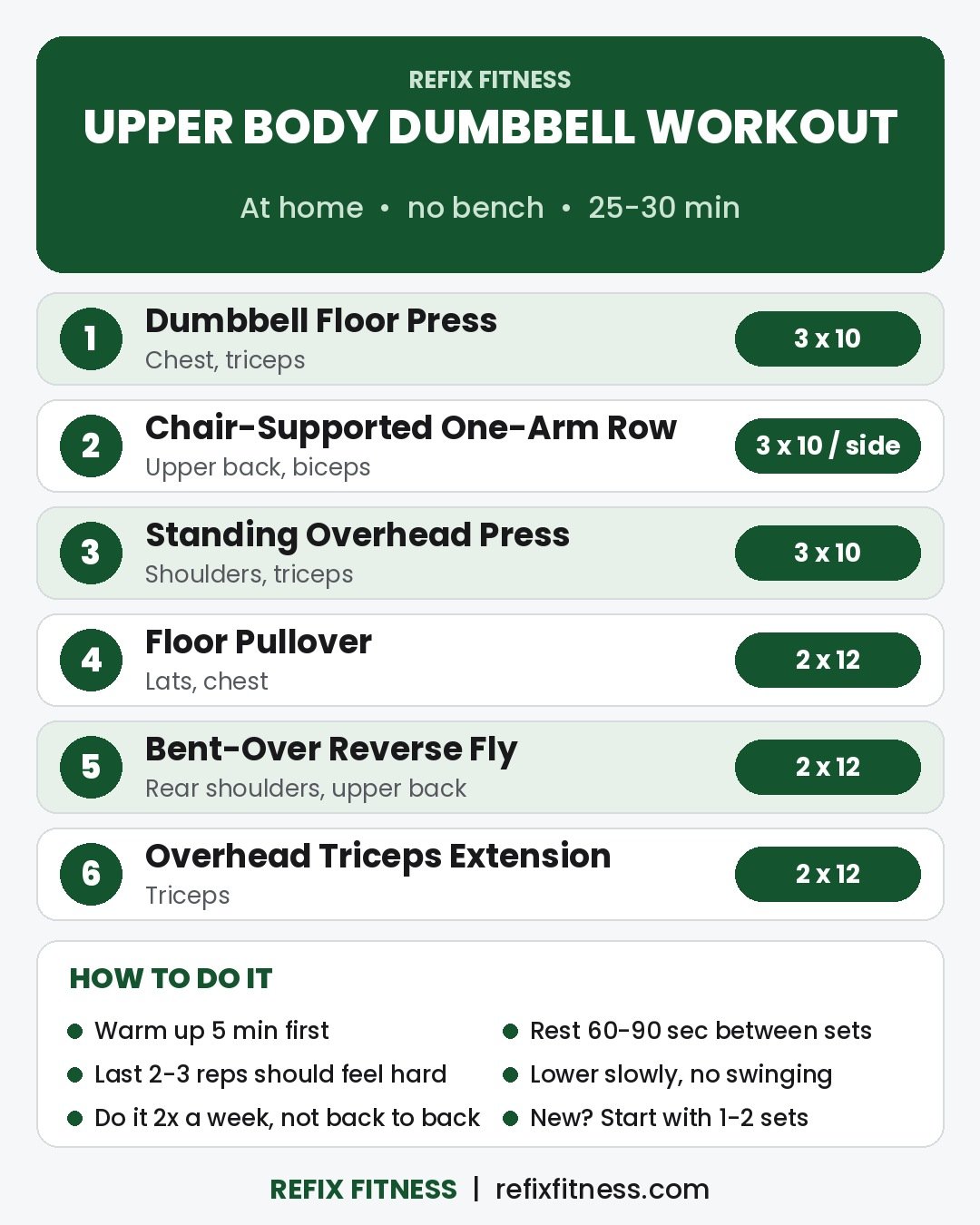
Quick answer: An upper body dumbbell workout at home with no bench can train your chest, back, shoulders and arms using just a pair of dumbbells, the floor and a sturdy chair. This plan uses 6 moves: dumbbell floor press, chair-supported one-arm row, standing overhead press, floor pullover, bent-over reverse fly and overhead triceps extension. Do 2-3 sets of each with slow, controlled reps, rest 60-90 seconds between sets, and repeat the workout 2 times a week with at least one rest day in between.
Below: choosing your weights, the plan, form cues, easier and harder options, a sample week, mistakes and FAQs.
Why Train Your Upper Body With Dumbbells at Home?
One pair of dumbbells covers pushing, pulling and pressing, and you don’t need a weight bench: the floor works as a press station, and a dining chair supports your rows.
A balanced upper body session needs more than biceps curls. It should include a push (chest), a pull (back), an overhead press (shoulders) and some arm work. This plan gives your upper back extra attention.
Your upper body is also a big part of the official guidelines. The NHS physical activity guidelines for adults recommend strengthening activities that work all the major muscle groups, including the back, chest, shoulders and arms, on at least 2 days a week, plus at least 150 minutes of moderate activity. Pair it with a leg day, such as our dumbbell lower body workout at home with no bench, and you have a simple full-body week with the same equipment.
What You’ll Need
- A pair of dumbbells. Light to moderate weight is a good place to start.
- A mat or carpet for the floor press and pullover.
- A sturdy chair without wheels for the one-arm row.
- About 25-30 minutes, including a 5-minute warm-up.
How Heavy Should Your Dumbbells Be?
There’s no single right number, because your back can usually handle more weight than your shoulders or triceps. Use this simple test instead: choose a weight you can lift for every rep with good form, where the last 2-3 reps feel hard. Mayo Clinic’s strength training guide describes a similar approach: pick a weight heavy enough to tire your muscles after about 12 to 15 repetitions, and increase it gradually once you can easily do more.
Only own one pair? Make a light weight harder with slower lowering and pauses, and a heavy one easier by working one arm at a time.
Upper Body Dumbbell Workout at Home (No Bench): The 6-Move Plan
Warm up for about 5 minutes: march in place, then do 10 arm circles each way, 10 shoulder rolls and a few slow reps of each move with no weight. Do the moves in order, finishing all sets of one move before the next. Rest 60-90 seconds between sets. In your first week or two, 1-2 sets of each move is plenty.
| # | Exercise | Sets x Reps | Main Focus |
|---|---|---|---|
| 1 | Dumbbell Floor Press | 3 x 10 | Chest, triceps |
| 2 | Chair-Supported One-Arm Row | 3 x 10 per side | Upper back, biceps |
| 3 | Standing Overhead Press | 3 x 10 | Shoulders, triceps |
| 4 | Floor Pullover | 2 x 12 | Lats, chest |
| 5 | Bent-Over Reverse Fly | 2 x 12 | Rear shoulders, upper back |
| 6 | Overhead Triceps Extension | 2 x 12 | Triceps |
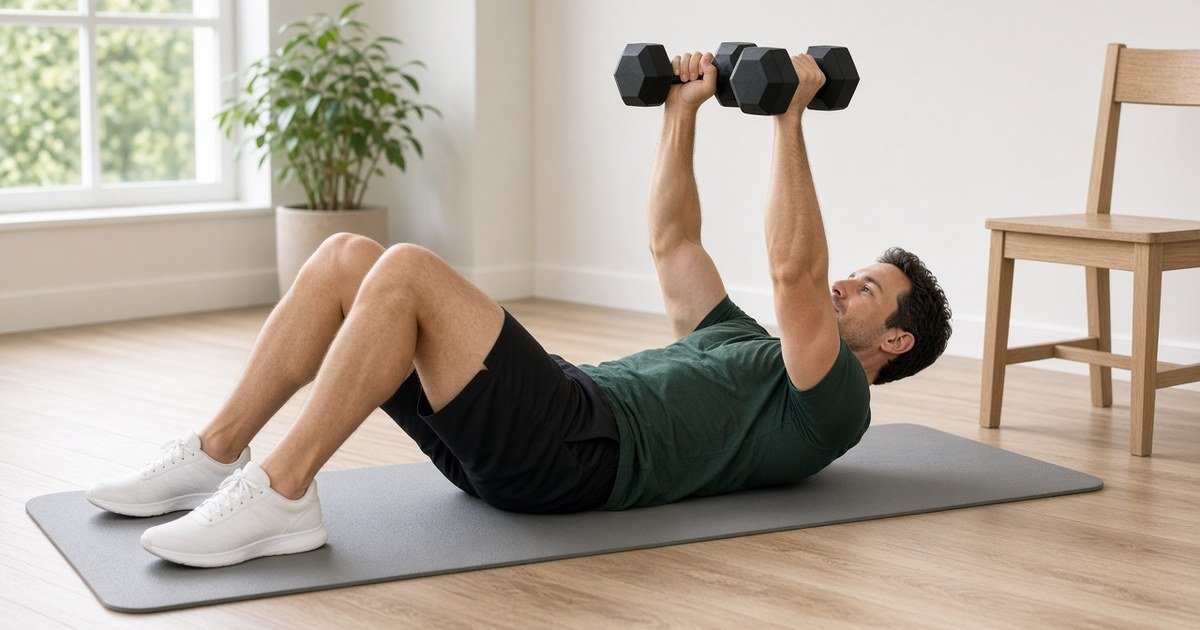
1. Dumbbell Floor Press
The no-bench version of the bench press. The floor stops your elbows at a comfortable depth.
- Lie on your back with your knees bent and feet flat. Hold a dumbbell in each hand with your upper arms resting on the floor, elbows angled about 45 degrees from your sides.
- Gently squeeze your shoulder blades together and brace your stomach.
- Press the dumbbells up over your chest until your arms are straight but not locked.
- Lower slowly until your upper arms lightly touch the floor, pause briefly, and press again.
Form cues: keep your wrists stacked over your elbows, and don’t let your elbows flare straight out to the sides or bounce off the floor.
Easier: use lighter dumbbells, or press one arm at a time. Harder: take 3 seconds to lower each rep, or pause for 2 seconds at the bottom.
2. Chair-Supported One-Arm Row
The main back move. The chair supports your upper body so your back stays flat and your arm can do the work.
- Stand beside a sturdy chair. Place your left hand on the seat and step your right foot back, hinging forward until your back is flat and roughly parallel to the floor or a little higher.
- Hold a dumbbell in your right hand, arm hanging straight down under your shoulder.
- Pull the dumbbell up toward your hip, leading with your elbow, until your elbow passes your ribs.
- Lower slowly until your arm is straight. Finish all reps, then switch sides.
Form cues: think “elbow to back pocket.” Don’t twist to lift the weight.
Easier: use a lighter dumbbell or a shorter range of motion. Harder: pause for 2 seconds at the top and squeeze your shoulder blade toward your spine.
3. Standing Overhead Press
Works your shoulders and triceps, while your core works to keep you upright.
- Stand with your feet hip-width apart and a soft bend in your knees. Hold the dumbbells at shoulder height, palms facing forward or facing each other.
- Brace your stomach and squeeze your glutes lightly.
- Press the dumbbells straight up until your arms are extended overhead, without locking your elbows hard.
- Lower slowly back to shoulder height.
Form cues: keep your ribs down and don’t lean back to push the weight up. If you have to arch, the dumbbells are too heavy.
Easier: sit on a sturdy chair, or press one arm at a time. Harder: lower for a slow 3-count, or try a staggered stance with one foot slightly forward.
4. Floor Pullover
Works your lats (the large muscles on the sides of your back) without a pull-up bar.
- Lie on your back with your knees bent and feet flat. Hold one dumbbell with both hands around one end, arms straight up over your chest.
- Keeping a slight bend in your elbows and your ribs down, slowly lower the dumbbell back over your head toward the floor.
- Go only as far as your shoulders comfortably allow; you don’t need to touch the floor.
- Pull the dumbbell back up over your chest, using the muscles under your arms.
Form cues: keep your lower back in contact with the mat. If your back arches as your arms go overhead, shorten the range.
Easier: use a lighter dumbbell, a water bottle or no weight. Harder: pause for 2 seconds at the lowest comfortable point.
5. Bent-Over Reverse Fly
Targets the back of your shoulders and upper back, the muscles that help you stand tall after a day at a desk.
- Hold a light dumbbell in each hand. Stand with feet hip-width apart, soften your knees and hinge forward at the hips with a flat back.
- Let your arms hang below your shoulders, palms facing each other, elbows slightly bent.
- Raise your arms out to the sides until they’re about level with your shoulders, squeezing your shoulder blades together.
- Lower slowly to the start.
Form cues: lead with your elbows and keep your neck long, eyes on the floor. This move needs much lighter weights than rows.
Easier: sit on the edge of a chair and lean forward, or use no weight. Harder: pause for 2 seconds at the top.
6. Overhead Triceps Extension
Finishes your arms by working the triceps, the muscles at the back of your upper arm.
- Stand or sit tall holding one dumbbell with both hands around one end.
- Press it overhead, then keep your upper arms close to your head.
- Bend your elbows to lower the dumbbell slowly behind your head.
- Straighten your arms to lift it back up, without moving your upper arms.
Form cues: keep your elbows pointing forward rather than flaring out, and keep your ribs down.
Easier: sit on a chair, use a lighter weight, or lie on the floor and lower the dumbbell beside your head. Harder: take 3 seconds to lower each rep.
For more arm work, our 5 lb dumbbell arm workout adds curls, kickbacks and lateral raises with light weights.
Sample Weekly Plan
Do this workout 2 times a week with at least one day off between sessions, so your upper body muscles have time to recover. Here’s one simple way to set up your week:
| Day | What to Do |
|---|---|
| Monday | Upper body dumbbell workout |
| Tuesday | Lower body workout |
| Wednesday | Brisk walk, 20-30 minutes |
| Thursday | Upper body dumbbell workout |
| Friday | Lower body workout or core workout |
| Saturday | Brisk walk, bike ride or gentle stretching |
| Sunday | Rest |
How to Progress Over the Weeks
Change one thing at a time. Spend the first 1-2 weeks on 1-2 sets per move, then build up to 3 sets. When the last few reps of a set start to feel easy, add 1-2 reps per set, slow down the lowering phase, or move up to a slightly heavier pair of dumbbells.
If you’re over 40 and want a full-body plan built around the same dumbbells, see our dumbbell workout for women over 40 at home.
Common Mistakes to Avoid
- Going too heavy too soon. If you’re swinging, arching or shrugging, drop the weight and slow down.
- Rounding your back on rows and flys. Hinge from your hips and keep your spine long from head to tailbone.
- Leaning back on overhead moves. Brace your stomach and keep your ribs stacked over your hips.
- Rushing the lowering phase. Lowering slowly keeps the work in your muscles and the weight under control.
- Holding your breath. Breathe out as you press or pull, and breathe in as you return.
Safety Tips
- Check with your doctor first if you haven’t exercised in a while, are pregnant or recently gave birth, or have a heart condition, high blood pressure, or a shoulder, elbow, wrist, neck or back problem.
- Clear your space and set dumbbells down gently on the floor, not on your chest.
- Stop if something feels wrong. Sharp pain in your shoulder, elbow, wrist or back, dizziness or chest discomfort are signs to stop, and get medical advice if they don’t settle.
FAQ
Can I build upper body strength with just dumbbells and no bench?
Yes. The floor press replaces the bench press, a chair supports your rows, and overhead presses work well standing. Together, these moves cover your chest, back, shoulders and arms.
How often should I do an upper body dumbbell workout at home?
Two times a week on non-consecutive days is a good starting point for beginners. That fits the common guideline of strengthening all major muscle groups on at least 2 days a week, and leaves a day of rest between sessions for the same muscles.
What weight dumbbells should a beginner use for upper body?
Choose a weight you can lift for every rep with good form, where the last 2-3 reps feel hard. Many beginners find they can use heavier dumbbells for rows and floor presses, and lighter ones for reverse flys and overhead moves.
Is the dumbbell floor press as good as a bench press?
For home training, it’s a practical substitute. The range is a little shorter because the floor stops your elbows, but it still works your chest and triceps.
Will this workout help me lose arm or belly fat?
You can’t choose where your body loses fat. Strength training builds muscle and can help with weight management as part of a routine that also includes regular aerobic activity and healthy eating, but results vary from person to person.
Disclaimer: This article is for general information only and is not medical advice or a substitute for advice, diagnosis, or treatment from a qualified doctor. Please talk to a healthcare professional before starting a new exercise program, especially if you have a health condition, and read our full disclaimer.
Disclaimer: This article is for general information only and is not a substitute for advice, diagnosis or treatment from a qualified doctor. Please talk to a healthcare professional before changing your diet, exercise or medicines, especially if you are pregnant, breastfeeding or have a health condition, and read our full disclaimer.