

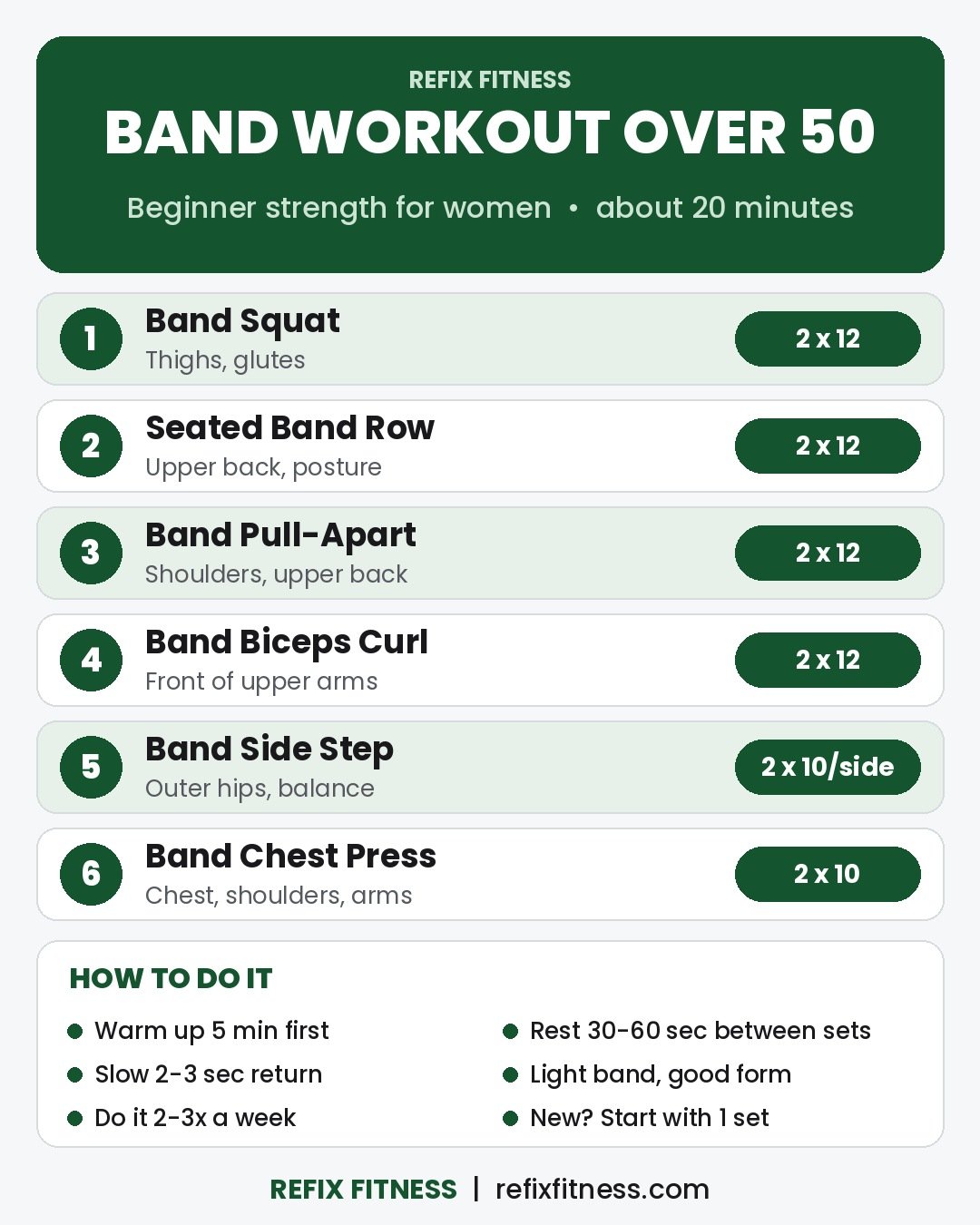
Quick answer: A good resistance band workout for women over 50 trains your whole body with slow, controlled moves you can do at home, mostly standing. This beginner routine uses 6 moves: band squat, seated band row, band pull-apart, band biceps curl, band side step and band chest press. Do 2 sets of 10-12 reps of each move (10 steps each way for the side step), rest 30-60 seconds between sets, and repeat the workout 2-3 times a week. It takes about 20 minutes and needs one long band, plus a small loop band if you have one.
Bands are light, quiet and easy to store, and you can make each move easier or harder just by changing your grip. Below you’ll find the plan, form tips, easier and harder options, a sample week, common mistakes and safety tips.
Why Strength Training With Bands Makes Sense After 50
The CDC recommends that adults do muscle-strengthening activities on at least 2 days a week, working all the major muscle groups: legs, hips, back, abdomen, chest, shoulders and arms. If dumbbells or the gym feel intimidating, a band helps:
- Gentle starting point. A light band gives real resistance without heavy loads in your hands.
- Easy to adjust. Hold the band shorter for more tension, longer for less, or switch to a lighter or heavier band.
- Practical strength. The moves copy everyday tasks like getting up from a chair, carrying bags, reaching and standing tall.
Strength work is one part of healthy aging, alongside daily movement, balance practice, good sleep and enough protein and calcium in your diet. For food ideas, see our guide to the best foods for strong bones.
What You’ll Need
- A long resistance band or tube with handles in a light or medium strength. Band colors mean different things across brands, so judge by feel: you should be able to finish each set with good form and have 2 or 3 reps left in the tank.
- A small loop (mini) band for side steps. If you don’t have one, tie the ends of your long band together, or simply do the side steps without a band at first.
- A sturdy chair without wheels for the seated row and for balance support.
Resistance Band Workout for Women Over 50: The 6-Move Plan
Warm up for about 5 minutes first: march in place, roll your shoulders, swing your arms gently and do a few slow sit-to-stands from your chair. Then do the moves below in order. Complete 2 sets of each move, resting 30-60 seconds between sets, before moving on. If you’re very new to exercise, start with 1 set of each move.
| # | Exercise | Sets x Reps | Main Focus |
|---|---|---|---|
| 1 | Band Squat | 2 x 12 | Thighs, glutes |
| 2 | Seated Band Row | 2 x 12 | Upper back, posture |
| 3 | Band Pull-Apart | 2 x 12 | Shoulders, upper back |
| 4 | Band Biceps Curl | 2 x 12 | Front of upper arms |
| 5 | Band Side Step | 2 x 10 steps each way | Outer hips, balance |
| 6 | Band Chest Press | 2 x 10 | Chest, shoulders, arms |
How to Do Each Move
1. Band Squat
Trains the muscles you use to stand up from a chair and climb stairs.
- Stand on the middle of the band with your feet hip- to shoulder-width apart.
- Hold one end in each hand at shoulder height, palms facing forward or toward each other.
- Push your hips back and bend your knees as if sitting into a chair. Go only as low as feels comfortable.
- Press through your whole foot to stand tall, squeezing your glutes at the top.
Form cues: keep your chest lifted, let your knees follow the line of your toes, and keep both feet firmly on the band so it can’t slip out.
Easier: place a chair behind you and lightly touch the seat with your hips on each rep, or do the squat without the band. Harder: take a wider grip lower on the band, or pause for 2 seconds at the bottom.
2. Seated Band Row
Rows strengthen the upper back muscles that help you sit and stand tall.
- Sit tall near the front of a sturdy chair, or on the floor with your legs straight out.
- Loop the middle of the band around the soles of your feet and hold one end in each hand, arms straight in front.
- Pull your elbows back close to your sides, squeezing your shoulder blades together.
- Slowly straighten your arms again, letting the band pull you forward a little without rounding your back.
Form cues: keep your shoulders down away from your ears, lead with your elbows, and avoid leaning back to finish the pull.
Easier: hold the band farther from your feet so there is less tension. Harder: choke up on the band, or add a 2-second squeeze when your elbows are back.
3. Band Pull-Apart
- Stand tall with your feet hip-width apart.
- Hold the band in front of your chest with both hands, about shoulder-width apart, arms nearly straight and palms facing down.
- Pull your hands out to the sides until the band touches or nears your chest, squeezing your shoulder blades together.
- Return slowly to the start, keeping tension on the band.
Form cues: keep a soft bend in your elbows, don’t shrug your shoulders, and keep your ribs down rather than arching your lower back.
Easier: hold your hands wider apart on the band. Harder: bring your hands closer together, or hold the pulled-apart position for 2 seconds.
4. Band Biceps Curl
Helps with lifting grocery bags and laundry baskets.
- Stand on the middle of the band with your feet hip-width apart.
- Hold one end in each hand, arms by your sides, palms facing forward.
- Keeping your elbows tucked at your sides, curl your hands up toward your shoulders.
- Lower slowly, taking about 2-3 seconds, until your arms are straight again.
Form cues: keep your wrists straight, stand tall without swinging, and don’t let the band snap your arms down.
Easier: stand on the band with one foot only, or work one arm at a time. Harder: stand with your feet wider on the band, or add a pause at the top.
5. Band Side Step
Targets the outer hip muscles that help keep you steady when you walk.
- Place a loop band around your legs just above your knees (easier) or around your ankles (harder).
- Stand with your feet hip-width apart and bend your knees slightly, hips back a little.
- Step your right foot out to the side, then follow with your left foot, keeping some tension on the band.
- Take 10 steps to the right, then 10 steps back to the left.
Form cues: keep your toes pointing forward, stay level instead of rocking side to side, and keep your feet from clicking together between steps.
Easier: do the steps without a band, or walk along a kitchen counter and hold it lightly. Harder: move the band down to your ankles, take slightly bigger steps, or sit a little lower.
6. Band Chest Press
A standing push move for your chest, shoulders and arms, with no floor work.
- Wrap the band around your upper back, just below your shoulder blades, and hold one end in each hand under your armpits.
- Stand tall with one foot slightly in front of the other for balance.
- Press both hands straight forward at chest height until your arms are almost straight.
- Bring your hands back slowly toward your chest.
Form cues: keep your elbows slightly below shoulder height, keep your wrists straight, and brace your stomach so your lower back doesn’t arch.
Easier: hold the band farther toward the ends, or do a wall push-up instead. Harder: wrap the band around your hands once more to shorten it, or press one arm at a time with a pause.
Sample Weekly Plan for Beginners
Aim for 2-3 band workouts a week on non-consecutive days, so your muscles have time to recover. Fill the other days with walking and gentle mobility work. Here’s a simple week:
- Monday: Band workout, 1-2 sets of each move
- Tuesday: Brisk walk, 20-30 minutes
- Wednesday: Band workout, 2 sets of each move
- Thursday: Walk plus 10 minutes of stretching (try these natural ways to improve flexibility)
- Friday: Band workout, 2 sets of each move
- Saturday: Longer walk, swim, bike ride or dance class
- Sunday: Rest
How to progress: when the last 2 or 3 reps of every set feel easy, change one thing at a time. Add a third set, shorten your grip on the band, or move up to the next band strength. Don’t change everything in the same week.
Want a second home routine to rotate in? Our stability ball workout for women over 50 trains your core and balance with the same gentle, beginner approach.
Common Mistakes to Avoid
- Letting the band snap back. The slow return is half the exercise. Count 2-3 seconds on the way back to the start.
- Picking a band that’s too strong. If you have to twist, lean or shrug to finish a rep, switch to a lighter band or loosen your grip.
- Shrugging your shoulders. On rows, pull-aparts and presses, think “shoulders down and back”.
- Holding your breath. Breathe out as you pull, press or stand up, and breathe in on the return.
- Using a worn-out band. Check for nicks, thin spots or sticky patches, and replace it if you see any.
Safety Tips
- Check with your doctor first if you haven’t exercised for a while, or if you have osteoporosis, a heart condition, high blood pressure, joint problems, or recent surgery or injury. A physical therapist can help you adjust moves for your body.
- Keep the band secure. Make sure it is firmly under your feet or around your body before you pull, and keep it away from your face.
- Use support for balance. Keep a sturdy chair or counter within reach, especially for squats and side steps. The NHS has more gentle strength exercises that use a chair for support.
- Stop if something hurts. Muscle effort and mild soreness the next day are normal. Sharp or joint pain, dizziness, chest discomfort or unusual shortness of breath are signs to stop and get medical advice.
FAQ
Are resistance bands good for women over 50?
For many women, yes. Bands are a low-cost, joint-friendly way to do muscle-strengthening activity at home, and the resistance is easy to adjust as you get stronger. Dumbbells and bodyweight moves work too; the best tool is the one you’ll use regularly and safely.
What resistance band strength should I start with?
Start with a light or light-medium band. Band colors aren’t standardized across brands, so go by how it feels: you should be able to finish 10-12 slow, controlled reps with good form and feel like you could do 2 or 3 more. If your form breaks down, go lighter.
How often should I do this resistance band workout?
Two to three times a week on non-consecutive days is a good start. Walking and stretching on the other days round out your week.
Can I do this workout sitting down?
Several moves work well seated. The row is already done sitting, and the pull-apart, biceps curl and chest press can all be done from a sturdy chair. For squats, use the chair as a target by sitting down and standing back up.
How long before I notice a difference?
It varies from person to person. Many people find the moves feel smoother and easier within a few weeks of steady practice, which is a sign to progress. Focus on showing up 2-3 times a week rather than on a deadline.
Disclaimer: This article is for general information only and is not medical advice or a substitute for advice, diagnosis, or treatment from a qualified doctor. Please talk to a healthcare professional before starting a new exercise program, especially if you have a health condition, and read our full disclaimer.
Disclaimer: This article is for general information only and is not a substitute for advice, diagnosis or treatment from a qualified doctor. Please talk to a healthcare professional before changing your diet, exercise or medicines, especially if you are pregnant, breastfeeding or have a health condition, and read our full disclaimer.