

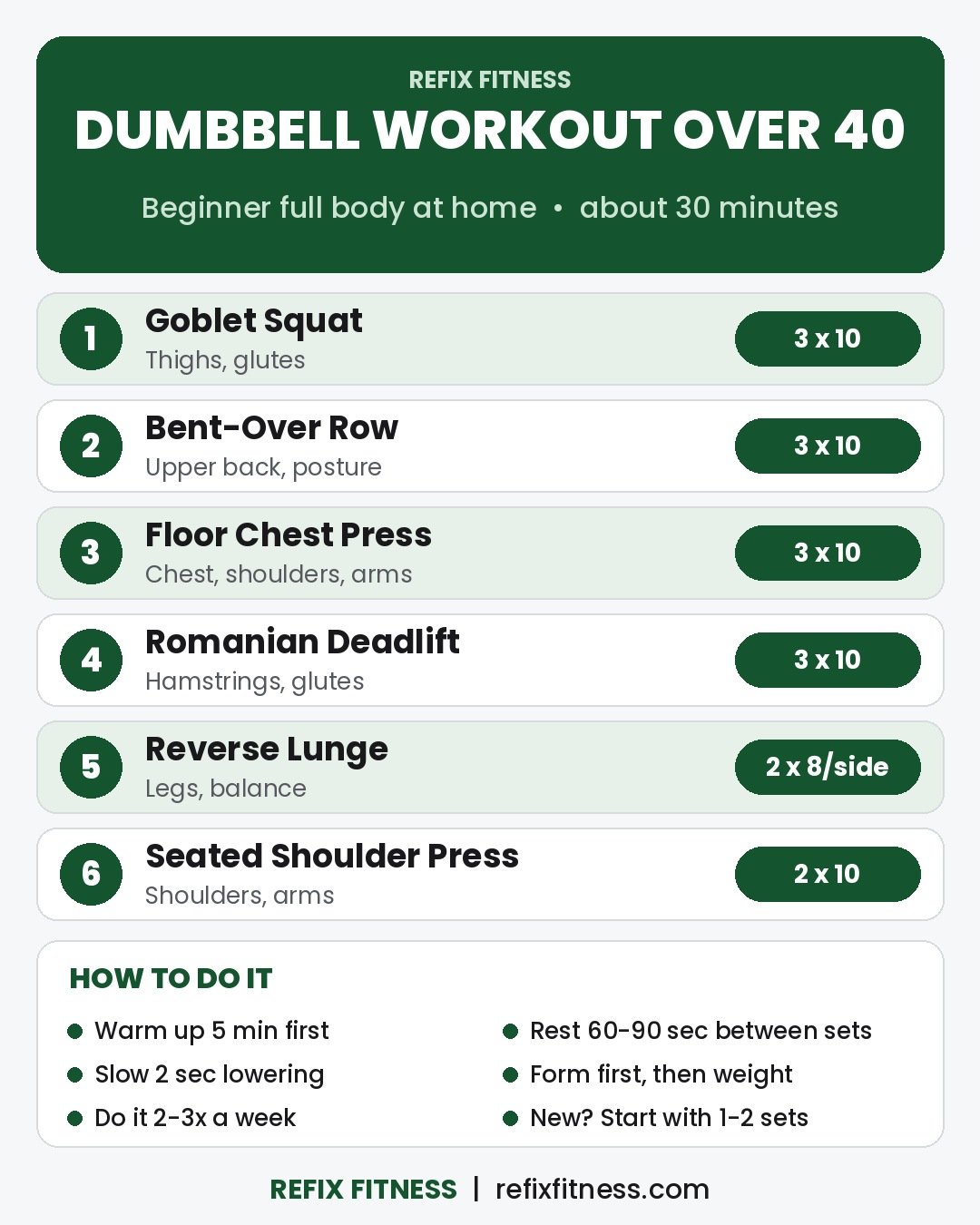
Quick answer: A simple dumbbell workout for women over 40 at home can train your whole body in about 30 minutes with just two dumbbells and a mat. This beginner plan uses 6 moves: goblet squat, bent-over row, floor chest press, Romanian deadlift, reverse lunge and seated shoulder press. Do 3 sets of 10 reps for the first four moves, and 2 sets for the reverse lunge (8 per side) and shoulder press (10 reps). Rest 60-90 seconds between sets and repeat the workout 2-3 times a week on non-consecutive days.
Below you’ll find the plan, form cues, easier and harder options, a sample week, common mistakes and safety tips.
Why Dumbbell Training Makes Sense After 40
The CDC recommends that adults do muscle-strengthening activities on at least 2 days a week, working all the major muscle groups: legs, hips, back, abdomen, chest, shoulders and arms. Mayo Clinic notes that lean muscle mass and strength tend to decline with age, and that strength training can help you keep them as you get older. A pair of dumbbells at home is one of the easiest ways to make that a habit:
- Easy to progress. Adding a little weight, a rep or a set gives your muscles a fresh challenge without changing the whole routine.
- Everyday strength. Squats, hinges, rows and presses copy real life: getting up from the floor, lifting a suitcase, carrying shopping and putting things on a high shelf.
Strength work pairs well with daily walking, good sleep and enough protein. For ideas, see our list of protein-rich Indian foods is a good place to start.
What You’ll Need
- Two pairs of dumbbells, if possible: a lighter pair for the shoulder press and a moderate pair for squats, rows and deadlifts. Your legs and back can usually handle more weight than your shoulders.
- A mat or carpet for the floor chest press.
- A sturdy chair or bench without wheels for the seated shoulder press and for balance support during lunges.
Dumbbell Workout for Women Over 40 at Home: The 6-Move Plan
Warm up for about 5 minutes first: march or walk in place, roll your shoulders, do a few bodyweight squats and some gentle hip hinges with your hands on your hips. Then do the moves below in order. Complete all sets of one move, resting 60-90 seconds between sets, before moving on. If you’re brand new to strength training, start with 1-2 sets of each move for the first couple of weeks.
| # | Exercise | Sets x Reps | Main Focus |
|---|---|---|---|
| 1 | Goblet Squat | 3 x 10 | Thighs, glutes |
| 2 | Bent-Over Row | 3 x 10 | Upper back, posture |
| 3 | Floor Chest Press | 3 x 10 | Chest, shoulders, arms |
| 4 | Romanian Deadlift | 3 x 10 | Hamstrings, glutes |
| 5 | Reverse Lunge | 2 x 8 per side | Legs, balance |
| 6 | Seated Shoulder Press | 2 x 10 | Shoulders, arms |
How to Do Each Move
1. Goblet Squat
Builds the leg strength you use to get up from a chair or the floor.
- Hold one dumbbell upright at your chest, cupping the top end with both hands.
- Stand with your feet about shoulder-width apart, toes turned out slightly.
- Push your hips back and bend your knees as if sitting into a chair. Go only as low as you can while keeping your chest up and heels down.
- Press through your whole foot to stand tall, squeezing your glutes at the top.
Form cues: keep the dumbbell close to your chest, let your knees follow the line of your toes, and take about 2 seconds to lower.
Easier: squat to a chair, lightly touching the seat with your hips on each rep, or use no weight. Harder: use a heavier dumbbell, or pause for 2 seconds at the bottom.
2. Bent-Over Row
Strengthens the upper back muscles that help you stand and sit tall.
- Hold a dumbbell in each hand, feet hip-width apart, knees softly bent.
- Hinge forward from your hips with a flat back until your upper body is at about a 45-degree angle, arms hanging below your shoulders.
- Pull the dumbbells up toward your lower ribs, leading with your elbows and squeezing your shoulder blades together.
- Lower slowly until your arms are straight again.
Form cues: keep your neck in line with your spine (look at the floor a little in front of you), keep your shoulders away from your ears, and don’t jerk the weights up.
Easier: do a one-arm row with your free hand resting on a sturdy chair or table for support. Harder: use heavier dumbbells, or hold the top position for 2 seconds.
3. Floor Chest Press
A shoulder-friendly push move, because the floor limits how far your elbows can travel.
- Lie on your back on a mat with your knees bent and feet flat on the floor.
- Hold a dumbbell in each hand, upper arms resting on the floor at about 45 degrees from your body, elbows bent and weights over your elbows.
- Press the dumbbells straight up over your chest until your arms are almost straight.
- Lower slowly until your upper arms lightly touch the floor, then press again.
Form cues: keep your wrists straight, don’t let your elbows flare out level with your shoulders, and keep your lower back relaxed on the mat.
Easier: use lighter weights, or do incline push-ups with your hands on a kitchen counter. Harder: take 3 seconds to lower, or pause with your elbows on the floor before each press.
4. Romanian Deadlift
Trains the back of your legs and hips.
- Stand tall with your feet hip-width apart, holding the dumbbells in front of your thighs.
- With a soft bend in your knees, push your hips back and slide the weights down the front of your legs.
- Lower until you feel a stretch in the back of your thighs, usually somewhere around knee or mid-shin height, while your back stays flat.
- Squeeze your glutes and drive your hips forward to stand tall.
Form cues: this is a hinge, not a squat, so your knees stay softly bent while your hips move back. Keep the dumbbells close to your legs and your shoulders pulled back.
Easier: practice the hinge without weights, or only lower to just above your knees. Harder: use heavier dumbbells, or slow the lowering phase to 3 seconds.
5. Reverse Lunge
Works each leg on its own and challenges your balance.
- Stand tall with your feet hip-width apart, holding a dumbbell in each hand by your sides (or no weights to start).
- Take a big step back with your right foot and lower your back knee toward the floor.
- Stop when both knees are bent at about 90 degrees, or sooner if that feels better.
- Press through your front foot to step back to standing. Do 8 reps on one side, then switch.
Form cues: keep your chest lifted, keep your front knee in line with your toes,.
Easier: hold a chair or counter with one hand, use no weights, or make the step shorter. Harder: hold heavier dumbbells, or add a 1-second pause just above the floor.
6. Seated Shoulder Press
Builds the shoulder strength you use to reach and lift things overhead. Sitting keeps you steady.
- Sit tall near the front of a sturdy chair or bench with your feet flat on the floor.
- Hold a dumbbell in each hand at shoulder height, palms facing forward or toward each other.
- Brace your stomach and press the weights up until your arms are almost straight.
- Lower slowly back to shoulder height.
Form cues: keep your ribs down rather than leaning back, don’t shrug at the top, and stop short of locking your elbows.
Easier: use your lighter pair, or press one arm at a time. Harder: do the press standing, or add a 2-second pause at the top.
Sample Weekly Plan for Beginners
Aim for 2-3 dumbbell workouts a week on non-consecutive days so your muscles have time to recover. Fill the other days with walking and light mobility work. Here’s a simple week:
- Monday: Dumbbell workout, 2 sets of each move
- Tuesday: Brisk walk, 20-30 minutes
- Wednesday: Dumbbell workout, full sets
- Thursday: Walk plus 10 minutes of stretching (try these natural ways to improve flexibility)
- Friday: Dumbbell workout, full sets
- Saturday: Longer walk, bike ride, swim or our low-impact workout at home with no jumping
- Sunday: Rest
How to progress: when you can finish every set with good form and the last reps no longer feel challenging, change one thing at a time. Add 1-2 reps per set, add a set to the lunge or shoulder press, or move up to the next dumbbell size. Don’t change everything in the same week.
Traveling or short on space? Our resistance band workout covers similar muscles and fits in a suitcase.
Common Mistakes to Avoid
- Going too heavy too soon. If you have to swing, twist or lean to finish a rep, the weight is too heavy for now. Good form comes first.
- Rounding your back on hinges. On rows and Romanian deadlifts, keep your back flat and only lower as far as you can control.
- Rushing the lowering phase. Count about 2 seconds on the way down. Dropping the weight skips half the work.
- Holding your breath. Breathe out as you lift, press or stand, and breathe in as you lower.
Safety Tips
- Check with your doctor first if you haven’t exercised for a while, or if you have a heart condition, high blood pressure, osteoporosis, joint or back problems, or recent surgery, injury or pregnancy. A physical therapist or qualified trainer can help you adjust the moves.
- Clear your space. Make sure the floor is dry and free of clutter, wear supportive shoes or train barefoot on a non-slip surface.
- Keep support nearby. Have a chair or counter within reach for lunges and squats, especially at first.
- Stop if something hurts. Muscle effort and mild soreness the next day are normal. Sharp or joint pain, dizziness, chest discomfort or unusual shortness of breath are signs to stop and get medical advice.
FAQ
What weight dumbbells should a woman over 40 start with?
It depends on your current strength, so there isn’t one right number. Many beginners use a lighter pair for shoulder and arm moves and a heavier pair for squats, rows and deadlifts. Pick a weight that lets you finish 10 controlled reps with good form while the last 2 or 3 feel challenging.
How often should I do this dumbbell workout?
Two to three times a week on non-consecutive days is a good start for most beginners. That meets the CDC’s suggestion of at least 2 days of muscle-strengthening activity, and the rest days let your muscles recover.
Can I do this workout with only one pair of dumbbells?
Yes. Choose a pair you can press overhead with good form, then make the leg moves harder by slowing down, adding pauses or adding reps.
Is lifting weights safe for women over 40?
For most healthy women, strength training with good form and sensible weights is a safe and useful part of a fitness routine. If you have a health condition, joint problem or haven’t exercised in a long time, talk to your doctor before starting.
How long before I notice a difference?
It varies from person to person. Many people find the moves feel smoother and the weights feel lighter after a few weeks of steady practice, which is your cue to progress. Focus on showing up 2-3 times a week rather than on a deadline.
Disclaimer: This article is for general information only and is not medical advice or a substitute for advice, diagnosis, or treatment from a qualified doctor. Please talk to a healthcare professional before starting a new exercise program, especially if you have a health condition, and read our full disclaimer.
Disclaimer: This article is for general information only and is not a substitute for advice, diagnosis or treatment from a qualified doctor. Please talk to a healthcare professional before changing your diet, exercise or medicines, especially if you are pregnant, breastfeeding or have a health condition, and read our full disclaimer.